
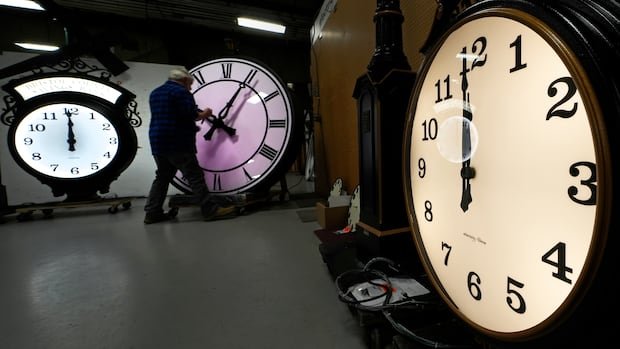

The global community has been utilizing “leap seconds” for over five decades to synchronize our clocks with the Earth’s rotation. Recently, a decision was made by an international timekeeping authority in France to eliminate leap seconds, allowing the clocks to gradually drift out of sync by a full hour, a process that could take hundreds or even thousands of years.
The precise atomic time, established in the 1950s through the measurement of atomic vibrations, slightly differs from solar time, which is based on the sun’s position in relation to a specific Earth location due to the gradual slowing of the planet’s rotation. To address this discrepancy, the leap second was introduced in 1972, with an immediate addition of ten seconds. The International Earth Rotation and Reference Systems Service has since been monitoring the difference between solar day and atomic time to determine when an extra second is necessary. Leap seconds, added 27 times thus far, were last implemented in 2016.
Not making these minor adjustments would have no noticeable impact in our lifetimes. However, as time progresses, there could be a shift leading to unusual daylight patterns. The concept is akin to leap years, where an extra day is added to February every four years to maintain alignment with the seasons.
There is growing consensus that leap seconds are causing more challenges than benefits. The decision to phase out abrupt leap seconds is motivated by the complications they pose to technology and communication systems reliant on precise timekeeping. Varying methods of leap second implementation among networks increase the risk of system failures, as witnessed in incidents such as Reddit and LinkedIn crashes in 2012 and Cloudflare outages in 2016.
Additionally, the Earth’s rotation has accelerated over the past six years, raising the prospect of a “negative leap second” in the future where a second would need to be subtracted. The International Bureau of Weights and Measures has opted to accumulate these additional seconds to an hour before making adjustments, a change set to take effect in May 2027.
Despite the challenges, experts acknowledge the complexities of Earth’s rotation and the imperfections in timekeeping systems. Samantha Lawler, an astronomy professor, emphasizes the constant adjustments needed due to various factors influencing the Earth’s rotation speed. She suggests that accepting a margin of error in timekeeping is inherent in the human endeavor of tracking celestial movements and natural patterns.
In conclusion, the decision to phase out leap seconds aims to address the growing complexities in timekeeping systems while acknowledging the ever-changing nature of Earth’s rotation.