
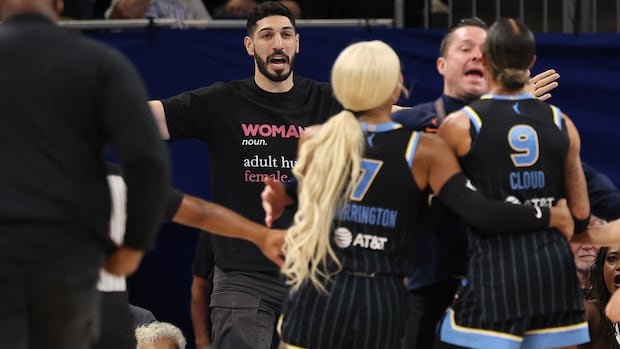

On Sunday evening, the Chicago Sky faced off against the Indiana Fever at Wintrust Arena, with the Fever emerging victorious with a score of 113-90, propelled by Caitlin Clark. What has made this game widely discussed is not just the display of women’s basketball skills but the incident involving former NBA player Enes Kanter Freedom, who engaged in a verbal dispute with Natasha Cloud of the Sky near the court boundary.
Natasha Cloud, a prominent and outspoken player known for her advocacy on social justice matters, found herself in a confrontation with Freedom, leading to his ejection from the venue. The altercation raised questions about why a retired basketball pro would involve himself in an in-game dispute, purportedly entering a debate regarding transgender women in the WNBA despite the absence of openly transgender players in the league.
Sporting a shirt reading “Woman 🔊noun. Adult human female,” Freedom attempted to make a satirical statement about biological females, positioning himself as an authority on the issue. Despite concerns by Cloud, who was named the game’s MVP, that she might have become a distraction for the team, coach Tyler Marsh reassured her of the team’s unwavering support.
Freedom’s actions aimed to draw attention to the purported need for safeguarding women’s sports, generating public pressure and social media buzz, albeit overshadowing reality. His recent declaration to enter the 2027 WNBA draft, along with another player, Royce White, under the guise of identifying as women, was deemed a social media gimmick.
Reports later confirmed that Freedom would not meet the eligibility criteria to play in the WNBA, highlighting the performative nature of his appearance at the Sky versus Fever game. The orchestrated clash involving Cunningham, known for her stance against the inclusion of transgender women in sports, and Freedom, emphasized the recurring theme of men inserting themselves into discussions surrounding women’s sports.
Instances of male interference in women’s sports are not uncommon, often manifesting through provocations and self-serving displays, as seen in Freedom’s actions at the game. The alarming focus on trans women in sports, despite the WNBA players’ association’s solidarity with the trans community, underscores misplaced priorities and the need to address more pressing issues like climate change and reproductive rights.
Advocacy driven by narcissism rather than genuine care poses a threat to the integrity of women’s sports, prompting concerns among those genuinely committed to promoting equity and fairness in sports. The incident involving Cloud and Freedom serves as a stark reminder of the risks women face in such confrontations, emphasizing the importance of safeguarding women’s spaces from unwarranted intrusion and disruption.
Moving forward, it is imperative for individuals like Freedom to redirect their efforts towards causes they genuinely care about and leave the advocacy for women’s sports to those who hold a sincere appreciation for its significance and impact.