
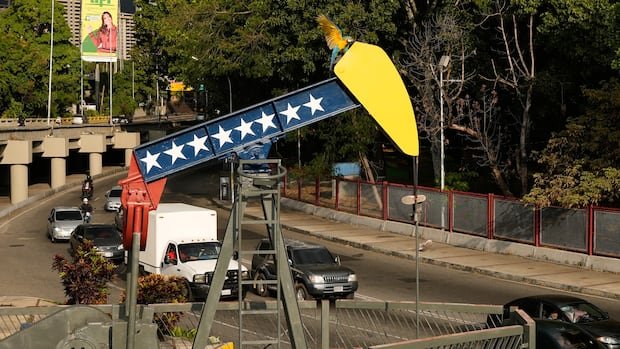

The U.S. President, Donald Trump, is persisting in his efforts to tap into Venezuela’s oil potential by revealing a fresh agreement designed to enhance production in the South American nation. Trump is portraying a potential controlling share in a segment of Venezuela’s oil reserves as a signal to Canada, but experts suggest Western Canada has little need for concern.
With Venezuela and Alberta both producing similar heavy oil types, an upsurge in Venezuelan exports to U.S. Gulf Coast refineries could pose a competitive challenge to the Alberta oil sector. Despite Venezuela’s vast underground oil reservoirs, the country confronts numerous hurdles in scaling up production, including political instability that could thwart efforts to revive its oil industry.
Meanwhile, the Canadian oil industry continues to achieve new production records, with multiple pipeline projects at different developmental stages aimed at bolstering export capacities. Despite ongoing trade tensions, the U.S. remains a significant consumer of Canadian oil, accounting for over 60% of the country’s crude oil imports last year.
Experts predict a noticeable surge in Venezuelan oil exports is still several years away, alleviating any immediate threat to Canada. Ed Sprague, a former deputy energy minister in Alberta, highlights the substantial time and financial investment required for the U.S. to pursue the deal with Venezuela, emphasizing the current lack of clarity surrounding the agreement.
In the recent announcement, Trump disclosed a deal with Venezuela to secure majority control over a fifth of the country’s oil reserves, with the U.S. obtaining a direct equity stake in a private company led by a Venezuelan entrepreneur. While Trump touts the agreement as a means to enhance U.S. oil supply and gain control over 65 billion barrels of reserves, Venezuela’s acting president, Delcy Rodríguez, anticipates significant investment inflows while safeguarding the country’s sovereignty over its natural resources.
The divergent messages from Trump and Venezuelan officials have raised uncertainties among analysts like Al Salazar, who underscores the ambiguity surrounding the deal’s terms. Canadian oil executives are cautiously monitoring the situation, awaiting tangible progress in revitalizing Venezuela’s oil sector before making any significant reactions.
The Trump administration has been urging American oil and gas firms to invest in Venezuela’s energy industry following prior military actions in the country, underscoring the strategic importance of Venezuela’s oil reserves.
In contrast, Canada’s heavy oil primarily originates from the oilsands in Northern Alberta, where established facilities continuously produce oil at low costs. This stands in stark contrast to Venezuela’s struggles, with its oil production declining due to sanctions and inadequate government policies, leading to infrastructure decay and funding uncertainties.
Political instability in Venezuela further complicates the scenario, with the potential for leadership changes impacting the country’s oil industry revival. Foreign companies eyeing investments in Venezuela face considerable cost and political risks, given past instances of asset seizures.
While some companies like Shell and Repsol show interest in investing in Venezuela’s oil and gas sector, uncertainties persist. Former Alberta deputy energy minister Ed Sprague reassures that Canada’s oil industry remains resilient, emphasizing the country’s expanding export markets and ongoing pipeline projects to diversify oil supply destinations.
Overall, the U.S.’ pursuit of various oil sources aligns with Canada’s strategy of diversifying its oil market reach, ensuring resilience and stability in the face of evolving global energy dynamics.