
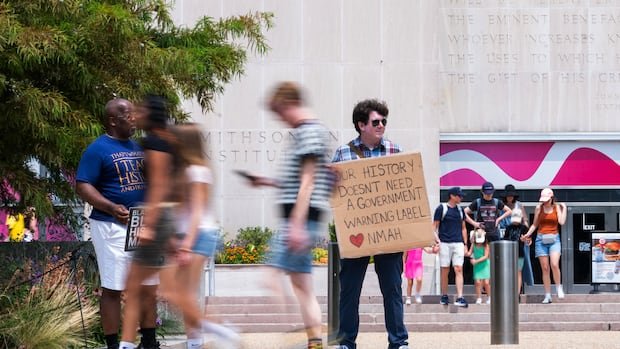

The Smithsonian’s National Museum of American History in Washington, D.C., attracts both Americans and global visitors keen on viewing iconic artifacts like Dorothy’s ruby slippers from the “Wizard of Oz,” inaugural gowns of U.S. first ladies, and the garrison flag that inspired the “Star-Spangled Banner.” Recently, protesters have been seen outside the museum, advocating for truth and inclusive history representation.
There is an ongoing effort by the Trump administration to influence the narratives presented by cultural institutions in the U.S., including the Smithsonian. President Trump has ordered the placement of signs cautioning visitors about alleged inaccuracies within the museum. The administration released a report critiquing the Smithsonian’s focus on divisive narratives over patriotism.
The Smithsonian, as the largest museum system globally, is defending its integrity amid these challenges. The museum’s director, Anthea Hartig, affirmed their commitment to accurate and comprehensive storytelling. Scholars and experts have praised the Smithsonian for resisting political pressures to alter historical content.
Despite the political scrutiny, surveys show that most Americans value the independence and inclusive nature of museums like the Smithsonian. While differing opinions exist on historical interpretations, the majority supports curatorial autonomy and diverse representation in cultural institutions.
Visitors to the museum have varied reactions to the exhibits, with some perceiving a leftist slant in the narratives presented. Nonetheless, many appreciate the diverse perspectives showcased in American history, acknowledging the complexity of the nation’s past.