
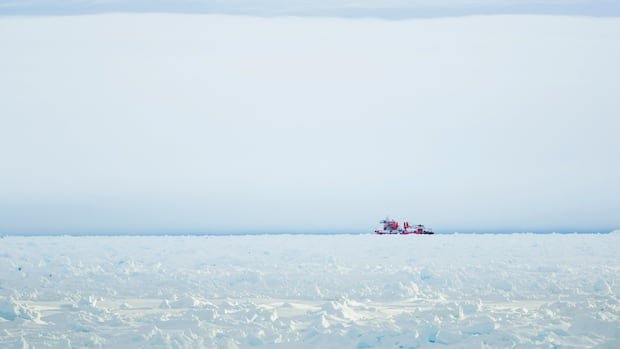

Canada and the United States have been discreetly monitoring two Chinese icebreaking research vessels in the Arctic waters near Alaska for the past few weeks. The ships, known as Xue Long (Snow Dragon) and Xue Long 2, were observed sailing north through the U.S. exclusive economic zone in the Bering Sea in July, as reported by the U.S. Coast Guard.
The presence of Chinese research vessels in the Arctic Ocean during summer has raised concerns among security and defense officials in recent years. Steffan Watkins, an independent research consultant and ship tracker, has gathered data indicating that a Royal Canadian Air Force CP-140 surveillance plane has been conducting operations in Alaska since early July.
The Department of National Defence confirmed on Friday that the Canadian Joint Operations Command is actively monitoring the movements of the two Chinese vessels in coordination with the U.S. authorities. These vessels are currently operating outside of Canada’s exclusive economic zone, which refers to the area beyond territorial waters where the country holds sovereign rights over resources and the jurisdiction to oversee activities such as research and environmental protection.
Last year, the Canadian military initiated a focused effort to enhance monitoring of northern waters and collaborate with allies in the Pacific, including the Bering Sea off Alaska, under Operation Latitude. The Royal Canadian Navy has deployed the frigate HMCS Ottawa, along with the Arctic offshore ships HMCS Max Bernays and HMCS Robert Hampton Gray, in addition to the air force’s surveillance aircraft. Canadian Special Operations Forces Command personnel and the icebreaker CCGS Des Groseilliers are also participating in these efforts.
Defence Minister David McGuinty emphasized that the Canadian military actively surveils the country’s waters. China, which has identified itself as a near-Arctic state, maintains that its icebreakers are deployed in the region solely for peaceful scientific research, environmental monitoring, and studies on global climate change. However, these research vessels have reportedly utilized advanced sonar and telemetry buoys, which are capable of not only monitoring environmental changes and undersea topography but also tracking submarine activity.
Richard Shimooka, a defense researcher at the Macdonald-Laurier Institute in Ottawa, highlighted the multifunctional capabilities of the Chinese research ships. He noted that while there are no major international undersea fiber-optic cables in the Bering Sea region, there exists a crucial regional subsea network vital to Alaska. Shimooka raised concerns about the Chinese mapping activities in this grid, similar to Russian efforts in the Baltic Sea and the North Atlantic.
As Canada assumes a more significant role in the western Pacific, especially amid the U.S. Navy’s engagements in the Iran conflict, Shimooka cautioned about the limitations posed by the aging Canadian navy’s frigates and coast guard ships. He emphasized the importance of modernizing the fleet to sustain current operations effectively.
Members of the House of Commons defence committee, including Conservative defence critic James Bezan, advocated for increased surveillance in the Arctic region. Bezan highlighted the growing interest of China in the Arctic and emphasized the need to bolster Canada’s monitoring capabilities to respond to such incursions effectively.
The federal government has initiated substantial investments in constructing new destroyers, procuring Arctic-capable submarines, and establishing an undersea sensor network to strengthen the country’s defense capabilities. Bezan stressed the urgency of safeguarding Canada’s sovereignty in the Far North, particularly in the face of challenges from Russia and China, who do not acknowledge Canada’s maritime claims in the region. He emphasized the importance of protecting the vast energy resources locked in the Arctic, including the Beaufort Sea, against potential adversaries.