
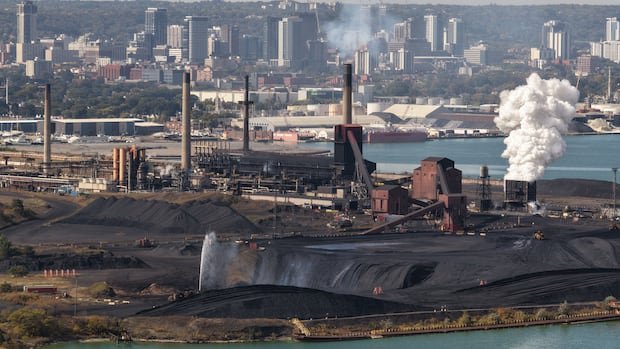

Ottawa has given the U.S. owner of Stelco a five-day ultimatum to present a strategy for preserving jobs at the Hamilton steelmaker or face potential legal repercussions. Last week, Ohio’s Cleveland-Cliffs announced intentions to lay off up to 500 employees as it suspends specific steel production operations at Stelco, breaching commitments made during its 2024 acquisition. In a letter addressed to Stelco President Paul Simon on Monday, Industry Minister Mélanie Joly warned of potential court intervention under the Investment Canada Act to enforce the agreement.
“The Government of Canada places significant importance on upholding commitments,” Joly stated in the letter obtained by CBC News. Joly emphasized that if an investor fails to honor an undertaking, the Act offers remedies for violations, such as court orders mandating compliance, divestment, or financial penalties. Joly expressed hope that such measures would not be necessary.
Cleveland-Cliffs acquired Stelco in a deal worth $3.4 billion, emphasizing the preservation of national interests and the significance of the workforce. According to Joly’s correspondence, the acquisition entailed commitments to maintain the same number of unionized and non-unionized employees as at the time of the transaction announcement.
CEO Lourenco Goncalves of Cleveland-Cliffs justified the layoffs citing the Canada-U.S. trade war, asserting that Stelco’s ability to export steel to the U.S. was a pivotal condition of the agreement. Despite changing business strategies or market conditions, Joly affirmed that the company’s commitments remain valid.
Prime Minister Mark Carney vowed to utilize all available legal measures against Cleveland-Cliffs, emphasizing Ottawa’s determination to pursue the company to the fullest extent of the law. Cleveland-Cliffs was contacted for comment by CBC News on Tuesday.
Regarding potential outcomes, foreign takeover commitments under the Investment Canada Act typically span five years and encompass factors like the acquiring company’s investment levels and workforce retention. Sandy Walker, co-chair of the competition and foreign investment review group at Dentons, explained that non-compliance could prompt a demand letter from the minister, followed by potential legal action if the government is unsatisfied with the company’s response.
In a previous case in 2009, Industry Canada sued Stelco’s former owner, U.S. Steel, over job protection commitments, ultimately reaching an out-of-court settlement in 2011. Ron Wells, president of United Steelworkers Local 1005, expressed skepticism about Stelco reversing its layoff plans despite government pressure. An internal memo attributed the layoffs to stiff competition from imported steel products.
Ontario’s government pledged over $200,000 in collaboration with Ottawa through the Canada-Ontario Workforce Tariff Response to support steel and manufacturing workers in Hamilton. The funding aims to assist 75 workers in upgrading skills and transitioning to high-demand careers, as stated by the province’s labour minister, Trevor Jones.
Goncalves has voiced support for Trump’s Section 232 measures imposing tariffs on Canadian steel and aluminum imports. He affirmed backing for Canadian steelworkers, emphasizing that “America first is not America only.” Trump recently highlighted a $15 billion investment plan by Minnesota-based steelmaker Mesabi Metallics as a success of his administration’s steel import tariffs.