
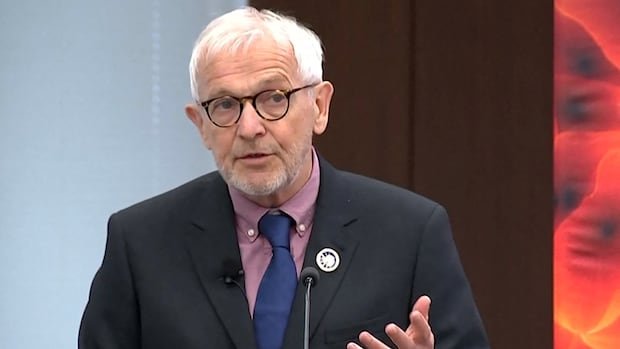

Belgian American physicist Francis Halzen, 82, was named as the recipient of the 2026 Nobel Prize in Physics in Stockholm. Halzen was honored for his significant contributions to the IceCube Neutrino Observatory and the identification of high-energy neutrinos originating from space, situated at the Amundsen–Scott South Pole Station in Antarctica.
Recognizing the potential of using ice at the South Pole to track neutrinos, which are known as “ghost particles” due to their ability to travel through the Earth and matter without leaving a mark, Halzen’s innovative approach has provided valuable insights into the cosmos. The IceCube Observatory, covering a cubic kilometer, was established in 2011, fulfilling a vision that originated in the late 1980s.
Referred to as “Neutrino Man” by the U.S.-based Smithsonian magazine in 2014, Halzen expressed his gratitude to his collaborators over the years for the success of the project. The observatory’s extension, IceCube-Gen2, covering eight cubic kilometers of ice and set to be operational in 2033, aims to detect a greater number of neutrinos, including weaker ones.
Neutrinos, omnipresent cosmic particles with a minuscule mass, are crucial in unraveling the mysteries of the universe. Halzen’s work with a unique set of neutrinos has provided essential clues to the universe’s evolution, paving the way for a new era in astronomy.
The announcement of the Nobel Prize in Chemistry will follow on Wednesday, with the literature prize on Thursday and the peace prize on Friday. The economics prize will be revealed on October 12. The Nobel prizes, established by Alfred Nobel, aim to recognize individuals who have made significant contributions to humanity, with the laureates being presented with the awards on December 10 each year.