
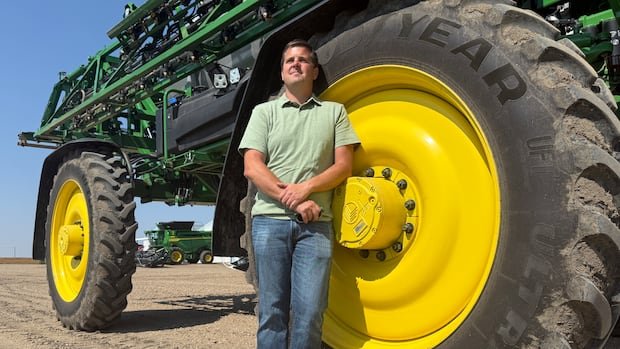

In Coleville, Saskatchewan, Dean Roberts observed a sizable grey drone soar over his 4,000-hectare farm, which grows various crops like canola, wheat, barley, and lentils. The drone, a DJI T100, outfitted with a 100-liter tank for spraying pesticides on crops, received approval from the Canadian government in June. During a demonstration, the tank was filled with water as Roberts discussed the potential benefits of this technology for his farm’s operations.
Roberts mentioned that the drone represents the latest technological advancement embraced by Prairie farmers to enhance crop yields. Despite this progress, he noted that Canada lags behind countries like the U.S., China, Brazil, Japan, and Australia in permitting drone spraying.
Regulatory barriers have hindered the adoption of agricultural technology in Canada, according to Roberts. Factors such as red tape, infrastructure challenges, and labor shortages impede the country’s capacity to expand food exports while other nations advance in this area.
Statistics show that Canada’s share of global food exports has declined, despite overall growth in food production. Efforts are underway to address these issues, including rebranding pesticide regulation to streamline product approvals and timelines.
Infrastructure limitations and labor scarcity pose additional hurdles for farmers like Roberts. Transportation constraints, particularly rail delays, hinder the timely delivery of crops to export markets. Moreover, finding skilled workers for seasonal farming tasks remains a significant challenge.
Stakeholders emphasize the necessity of engaging with policymakers to address these challenges effectively. They stress the importance of investing in critical infrastructure projects and streamlining trade processes to support the growth of the agri-food sector in Canada.
While the government aims to boost agri-food exports, experts caution that the focus should also be on enhancing domestic food production sustainably. They advocate for a strategic approach that promotes eco-friendly agriculture and supports global food security without compromising local producers’ livelihoods.
In light of climate change projections favoring Canada’s agricultural productivity, experts urge the country to prepare for a more prominent role as an agricultural powerhouse. They emphasize the need for proactive measures to capitalize on changing agricultural dynamics and position Canada as a key player in global food supply.
Roberts believes that Canada possesses the resources and climate conducive to feeding a significant portion of the world’s population, highlighting the country’s potential to contribute substantially to global food security.