

The recent encirclement of Palestinian residences by aggressive Israeli settlers in Qusra village within the occupied West Bank is not an isolated event. However, the U.S. citizenship of one of the Palestinian homeowners has sparked significant media interest compared to the usual acts of aggression by hardline Jewish settlers aiming to displace Palestinians from their properties.
Ohio-based entrepreneur Loui Ridi traveled back to Qusra on August 17 to safeguard his residence, where his brother and nephew reside, amidst a tense situation with settlers surrounding it and two neighboring homes. Ridi shared in a video call with CBC news that his brother expressed the need for food but was reluctant to leave the house due to the settlers’ presence, fearing they might seize the property.
Ridi highlighted a recent incident in a nearby village where settlers imposed a siege on a family, ultimately forcing them out of their home. Israeli settlements in the occupied West Bank are deemed unlawful under international regulations and have notably expanded under the current leadership of Israeli Prime Minister Benjamin Netanyahu and his ultranationalist allies, who are criticized for tolerating settler violence.
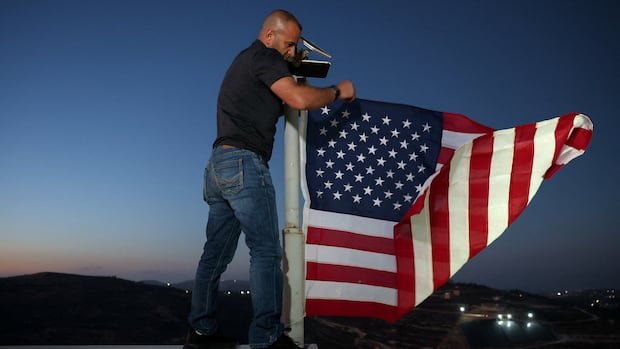
Upon returning to Qusra, one of Ridi’s initial actions was hoisting an American flag on his building, seeking assistance from the U.S. Embassy. The village of Qusra, located about 16 kilometers south of Nablus, is surrounded by settlement blocs and outposts occupied by radical settlers, including Migdalim and Shilo.
The United Nations Office for the Coordination of Humanitarian Affairs reports an average of six incidents of settler attacks causing casualties or property damage daily this year, marking a record high. The U.S. Ambassador to Israel, Mike Huckabee, condemned the violence in Qusra, labeling those responsible as “Israeli terrorists” in a social media post and subsequent televised interview.
Huckabee, a staunch supporter of Israel’s settlement policy, defended Jewish claims to the land based on biblical rights, referring to the West Bank as Judea and Samaria. While he downplayed violent settlers as a minority, critics argue that such actions represent a broader pattern of institutional annexation and land appropriation that relies on violence.
Dror Etkes, founder of Kerem Navot, an Israeli NGO monitoring settlements, emphasized the systemic issue fueling violence in Qusra, pointing to the ongoing expansion of settlements at the expense of Palestinian territories. The presence of Israeli border police and IDF units in Qusra aimed to restore order and remove settlers blockading Palestinian homes.
Ongoing tensions in Qusra have raised concerns about the collaboration between Israeli forces and settlers, reinforcing Palestinian beliefs that the IDF enables settlement activities. CBC News reported instances where Israeli soldiers engaged in questionable actions during the siege, further blurring the line between military and settler operations.
The escalation of violence on the outskirts of Palestinian communities, as witnessed in Qusra, is part of a broader strategy to confine Palestinians to smaller areas, facilitating the connection of settlement blocs and outposts across the West Bank. The international community, including Canada, France, Germany, and the UK, has criticized Israel’s expansion plans, such as the construction tenders for a new settlement near East Jerusalem, jeopardizing the two-state solution and territorial integrity of Palestinian territories.