
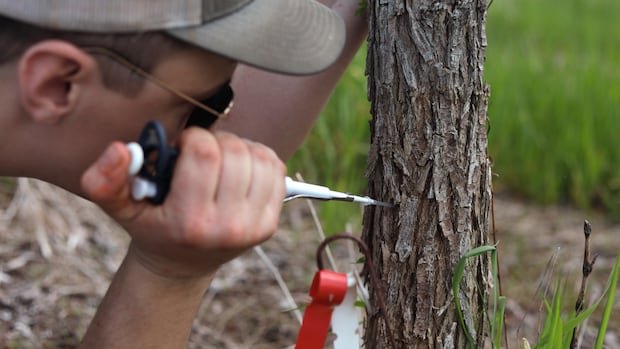

In Vermont, scientists have been intentionally infecting thousands of trees with Dutch elm disease over the summer. This unusual practice is part of an experiment conducted by researchers from the U.S. Forest Service and the Nature Conservancy. The aim is to assess the potential resistance of a new generation of elms, bred from disease survivors, against the fungus spread by bark beetles that has been devastating elm populations in the U.S. and Canada for many years.
Gus Goodwin, a senior conservation planner at The Nature Conservancy, expressed the devastating impact of losing elm trees over the years. The hope is that this experiment in Vermont, along with similar efforts in Canada, will lead to the development of elm strains that are resistant to Dutch elm disease (DED) as the disease continues to pose a threat in new regions.
The loss of elm trees due to DED has been particularly significant in Fredericton, once known as the “City of Stately Elms,” where an estimated 10,000 trees were lost during the 1960s and 70s. Today, only around 1,000 mature elms remain. Anthony Taylor, a forest management professor at the University of New Brunswick, noted the ongoing challenge of the disease affecting even trees that initially survived its spread.
The destructive nature of Dutch elm disease occurs when bark beetles carrying the disease spores infest an elm tree, blocking its water-conducting tissues and leading to the tree’s eventual death within one to four years. To combat the spread of DED, infected elms are promptly removed, although past strategies like “sanitization” may have inadvertently diminished the population of disease-tolerant trees.
As the disease continues to threaten urban forests across Canada, cities like Edmonton and Saskatoon are facing increasing cases of infected elms. Efforts to contain the disease involve prompt removal of infected trees and community cooperation to prevent further spread. The loss of mature elm trees not only impacts the aesthetics of urban landscapes but also diminishes their ecological benefits, such as stormwater absorption and climate mitigation.
Various initiatives, including the Elm Recovery Project in Guelph and projects in Fredericton, are focusing on enhancing resilience against DED through breeding programs that select for disease-resistant traits. These long-term efforts aim to restore elm populations by cultivating generations of trees that can withstand the disease, potentially allowing elms to coexist with DED as seen in European populations. While natural evolution may eventually lead to disease tolerance in Canadian elms, expedited breeding programs offer a proactive approach to preserving these iconic trees.