
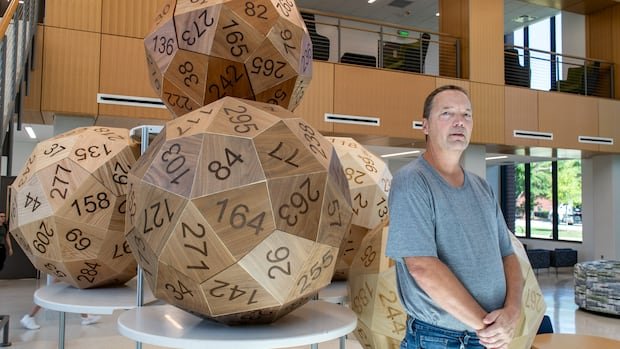

In a conversation at a gaming convention in 2012, a board game designer challenged mathematician Eric Harshbarger to create dice that could determine the starting player without any chance of a tie. The objective was to streamline the initial turn and expedite the game setup.
Harshbarger, a mathematician and senior lecturer at Auburn University in Alabama, found the task intriguing due to its lack of a straightforward solution, which often appeals to mathematicians. After theoretical deliberation, he devised a set of dice that offered each player an equal opportunity to win while ensuring no ties among participants.
However, translating this theoretical concept into functional dice proved to be a significant challenge. Nearly 15 years later, Harshbarger and his team successfully developed a set of specialized dice called the Go First Dice for five players. These dice enable fair determination of the first player in a board game, guaranteeing a winner from a single roll.
The project became a collaborative effort involving approximately 20 computer scientists and mathematicians worldwide. While creating a set of four 12-sided dice for two, three, or four players was relatively swift, devising a solution for five players presented a more complex puzzle.
After exploring various theories and reducing the number of sides, the team eventually settled on a set of five 120-sided dice, thanks to a breakthrough by a researcher from Australia. Subsequently, a Canadian software engineer, Paul Meyer, contributed by proposing a solution using five 60-sided dice.
Despite the immense computational challenge and the vast number of possible designs, Meyer’s approach led to a practical solution. The resulting golf-ball-sized dice are now commercially available, designed to ensure fairness in gameplay based on solid mathematical principles.
The research team continues to investigate the feasibility of using dice with fewer sides for a five-player set, with the minimum known to be 30 sides. They also explore the potential expansion of the concept to accommodate six players. Acknowledging the unpredictability of such endeavors, Harshbarger remains fascinated by the mathematical beauty and complexity of the problem, underscoring the persistent dedication of mathematicians to unraveling intricate challenges.