
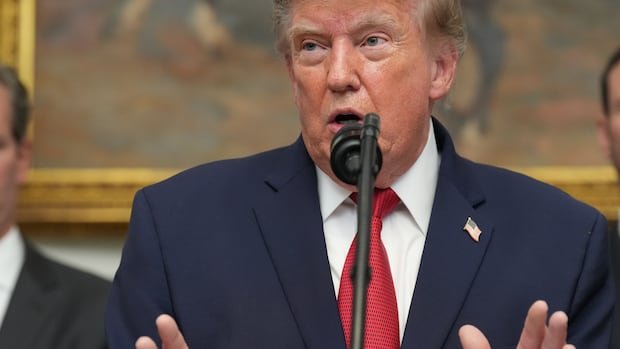

U.S. President Donald Trump declared on social media his intention to initiate what he termed as “the MOST CRUSHING ECONOMIC OPERATION EVER TAKEN AGAINST ANY COUNTRY” targeting Iran. Describing it as Economic Warfare and Isolation on an unparalleled level, he provided scant details in a post on Truth Social.
He issued a caution about the economic repercussions for any nation that supported Tehran or extended any form of assistance to Iran. Trump emphasized that any country permitting its financial institutions, businesses, airports, or government entities to aid Iran would face significant economic consequences.
Without specifying the precise measures Washington would implement against such a nation, Trump urged an immediate halt to activities like oil smuggling, swap lines, cash transfers, exchange houses, ship registries, and front companies. He stated, “You know who you are,” without directly naming any specific countries.
The ongoing conflict in the Gulf has resulted in numerous casualties over the past six months, with Iran demonstrating its ability to influence shipping through the Strait of Hormuz, a critical route for about one-fifth of the world’s traded oil. Despite ceasefire agreements announced by the U.S. and Iran in April and June to restore shipping flow through Hormuz, efforts to resolve the conflict have faltered. Israel, which had previously engaged in the conflict alongside the U.S., largely withdrew from the fighting.
Trump’s social media declarations and threats do not consistently materialize as originally stated. The situation is further complicated by conflicting reports regarding U.S.-Iran talks. The United Arab Emirates recently announced a suspension of all trade activities with Iran following allegations of missile launches from Iran, which were denied by Iran as baseless.
China, a significant importer of Iran’s oil, poses a challenge for the U.S. in engaging in further economic confrontations due to its status as a major exporter to the U.S., including vital rare-earth minerals. Despite the tensions, Iran’s Supreme Leader adviser expressed openness to dialogue with the U.S. while emphasizing that negotiations should not be equated with surrender.
While Trump denied ongoing talks with Iran, his son-in-law and special envoy, Jared Kushner, expressed optimism, stating that discussions with Iran were ongoing and potentially more substantial than ever.