
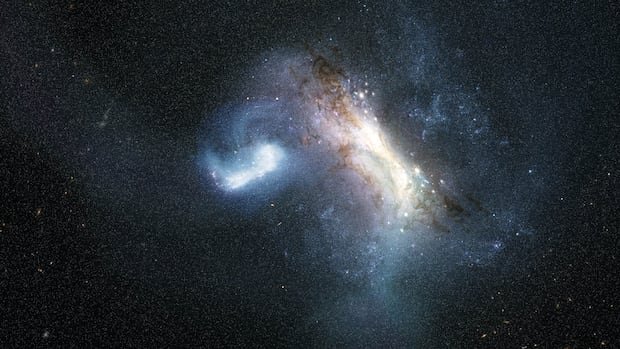

A recent study has shed light on the early history of the Milky Way galaxy, revealing a significant event that occurred approximately 11.8 billion years ago. Scientists have identified evidence of a galactic merger involving a smaller dwarf galaxy, known as Low-energy-Kraken-Heracles (LKH), which contributed to the growth of the Milky Way.
Using data from the Hubble and Gaia telescopes, researchers analyzed stellar clusters within the Milky Way’s central region, determining the age, chemical composition, and trajectory of the stars. The merger with the LKH galaxy introduced a substantial number of stars and interstellar gas to the Milky Way, fueling star formation and impacting the distribution of dark matter.
Astrophysicist Davide Massari, the lead author of the study, emphasized the significance of this discovery, highlighting that it marks the earliest-known galactic merger experienced by the Milky Way. The merger, while peaceful in terms of star interactions, triggered intense star formation due to the collision of gases from both galaxies.
The Milky Way has been involved in other galactic mergers in its history, including the absorption of the Gaia-Sausage-Enceladus dwarf galaxy and ongoing interactions with the Sagittarius dwarf galaxy. These merger events have played a crucial role in shaping the Milky Way’s structure and have implications for the formation of our solar system and Earth.
Understanding the Milky Way’s past through these mergers provides valuable insights into the origins of our galaxy and the universe as a whole. The research underscores the importance of unraveling the cosmic history of the Milky Way to answer fundamental questions about our existence.