
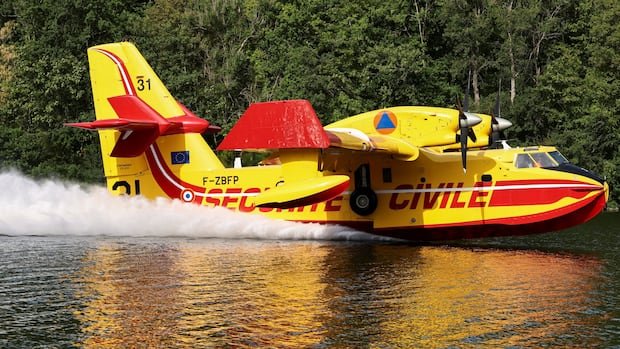

In the midst of a challenging wildfire season in Canada, the United States, and Europe, there is mounting pressure on De Havilland, the manufacturer of Canadair “Super Scooper” water bombers, to ramp up production. Political leaders are urging the federal government to place bulk orders for these planes.
De Havilland, based in Calgary, has decided to restart production of the Canadair after acquiring the water bomber program previously managed by Bombardier until 2015. The planes are meticulously handcrafted in Calgary, with assembly work sourced from various locations across Canada. The rejuvenated production line, initiated in 2022, is making progress, with the first two aircraft nearing completion and set for delivery in early 2028.
Authorities in Canada and Europe are eagerly awaiting these aircraft due to current shortages and aging fleets. Originally designed in the 1960s for combating large wildfires in the Canadian wilderness, the Canadair amphibious firefighting aircraft are uniquely equipped to navigate narrow canyons at low altitudes and swiftly scoop up thousands of liters of water from lakes, rivers, and oceans.
As demand for the Canadair grows, De Havilland is contemplating the possibility of establishing a second production line while continuing production at its existing facilities. The company is in discussions with the Canadian government and provincial leaders to secure a substantial order that would enable the expansion of production capacity.
At full capacity, De Havilland can manufacture around 10 water bombers annually, with plans to double this output through a second production line in the future. The company has pending orders for 38 aircraft, with delivery timelines extending to 2032-2033. The Canadair involves a vast number of components, with approximately 80% of the parts sourced locally in Canada.
Aviation expert John Gradek emphasizes the urgent need for additional production lines to meet the soaring global demand for water bombers, driven by the escalating threat of wildfires due to climate change. Failure to address this demand could potentially lead to foreign competitors developing rival firefighting aircraft, posing a risk to Canadian manufacturing jobs.
In response to the wildfire crisis, a recent Senate report recommended the establishment of a national fleet of modern firefighting aircraft in Canada. While the federal government has leased aircraft to assist provincial wildfire crews this season, there is a recognized need for a comprehensive strategy to combat wildfires effectively, with aerial firefighting units serving as just one part of the solution.
The federal government remains committed to enhancing the country’s wildfire response capabilities and collaborating with provincial and territorial authorities to mitigate the impacts of increasingly severe wildfire seasons.