

In the lobby of a tall building on Fifth Avenue, where even the ceiling appeared to be meticulously arranged, I observed a reality TV personality make a grand entrance into the realm of American politics by descending a gilded escalator.
Back in June 2015, the true implications of Donald Trump’s emergence were not fully grasped. This was not merely a show but a deliberate unveiling of a dangerous political strategy. With his bid for the presidency, he portrayed immigrants as criminals and painted grievances as acts of patriotism. It all seemed like a scripted performance, surreal even, as the host of The US Apprentice transitioned into a presidential candidate.
It was not just a theatrical display but the opening move in a calculated political offensive, built on division, fueled by spectacle, and aimed at perpetuating confrontation. The reverberations of this strategy continue to echo worldwide, now even reaching places like South East Manchester.
Since that pivotal day, I have closely monitored Trump’s playbook evolution, reshaping modern populism. He positioned himself as the advocate for the “forgotten” Americans while vilifying courts, journalists, and bureaucrats as corrupt adversaries. His narrative framed a battle between “the people” and an elitist establishment. Immigration transcended policy discourse to become a cultural battleground, with a border wall symbolizing strength and deportations serving as evidence of resolve.
Despite promises to uplift working families, Trump’s major legislative achievements have disproportionately favored corporations and the affluent. His billionaire associates flourished, some even dodging justice, while many workers struggled with stagnant wages and escalating living costs, if they were fortunate enough to retain their jobs.
Simultaneously, trade conflicts were initiated under the guise of safeguarding domestic industries, tariffs were imposed, and international alliances strained in the name of “America First.” Every setback was attributed to external forces, criticism labeled as sabotage, and dissenters branded as enemies. Loyalty trumped expertise, and division became the guiding principle, proving effective in its implementation.
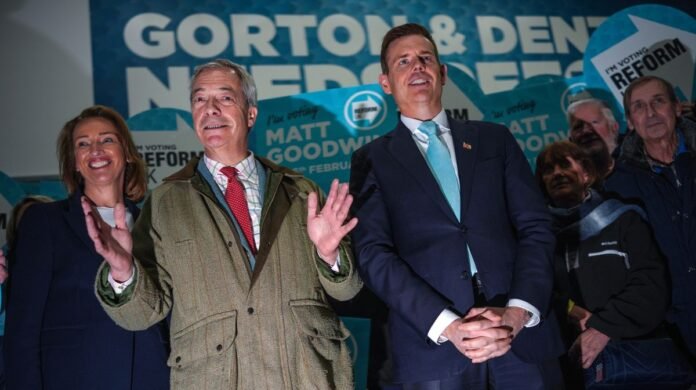
This should serve as a warning for every voter in Gorton and Denton, as they head to the polls not just to select parties but to determine whether a similar politics of grievances, confrontations, and personalities takes root in their community.
The parallels between Trump’s tactics and the strategies embraced by Nigel Farage and Reform UK are striking. Farage’s admiration for the US president is no secret, emulating Trump’s language and methods. His team, including figures like Zia Yusuf and Richard Tice, reflects this approach. The migration of not just individuals but rhetoric is evident within his circle.
What unites them is not detailed policy but rather the pursuit of political opportunities, the allure of the next spotlight, and the next step up the ladder. The similarities in their approach are hard to overlook.
Farage, a loyal Trump supporter, has cultivated an outsider persona, challenging the Westminster elites and championing Brexit as a battle for sovereignty against distant bureaucrats. His narrative of betrayal and restoration defines his political persona, even extending across the Atlantic to criticize his own country on foreign soil.
Today, immigration occupies a central position in Reform UK’s messaging, echoing Trump’s emphasis on drastic immigration cuts, stringent border control, and disengagement from global frameworks as simplistic solutions to complex issues. Immigration becomes not just a policy but a symbol of national resolve.
National sovereignty emerges as another shared theme, with both Trump’s “America First” doctrine and Farage’s political agenda focusing on reclaiming authority from international bodies. Both disdain global institutions, arguing they disadvantage ordinary citizens.
On economic matters, the similarities between the two deepen further. Trump’s tax cuts for corporations and deregulation align with Reform UK’s advocacy for lower taxes and reduced regulations, portraying smaller government as synonymous with freedom and garnering support from wealthy backers.
Their stances on energy policy also converge, with Trump promoting fossil fuel expansion and Farage’s camp criticizing green initiatives, portraying environmental caution as an impediment to economic progress.
However, beyond policy alignment, the real concern lies in their tone. Both Trump and Farage mastered the art of provocation, turning controversy into currency, leveraging social media for political gains, and prioritizing performance over policy substance.
The repercussions of such an approach are evident in the deep polarization that now plagues the United States, a stark contrast to the unity that once prevailed even in mundane settings like suburban dog parks. Britain’s political landscape may differ in structure and tradition, but the normalization of division and anger could fundamentally alter its political culture.
For the voters in Gorton and Denton, the choice transcends party politics, encompassing the type of governance they wish to see in their community. While frustration and economic strain may tempt embracing disruption, the American experience serves as a cautionary tale of the perils that come with grievance-driven politics.
Reform UK’s portrayal as the voice of the common citizen belies its economic agenda, mirroring policies that primarily benefit the affluent. The constituency of Gorton and Denton serves as a litmus test