
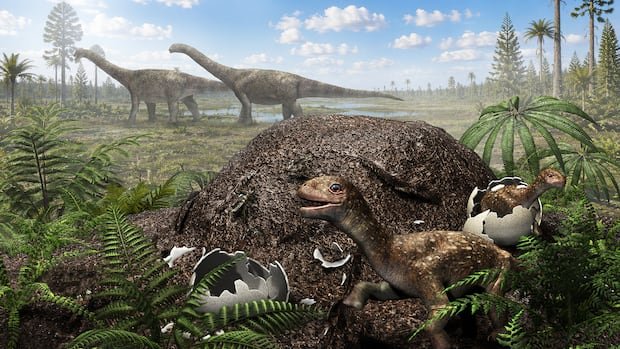

Fossilized eggshells believed to belong to some of the largest dinosaurs ever discovered have been unearthed in a surprisingly cool climate quite distant from the equator. Despite their colossal size, these titanosaurs could not rely on sitting on their volleyball-sized eggs to keep them warm, as they were too large, rendering the nest akin to one massive omelette.
A recent study, co-authored by University of Calgary paleontologist Darla Zelenitsky and researchers from Japan and Argentina, delves into the microscopic details to unravel how titanosaurs managed to maintain the optimal warmth for their eggs to hatch without direct brooding. By scrutinizing the tiny pores on the eggshells, the team proposes that titanosaurs adopted an incubation method akin to modern crocodiles, wherein they buried their eggs in warm piles of decaying vegetation to generate heat conducive for hatching.
Titanosaurs, colossal herbivorous dinosaurs characterized by their elongated necks and tails, massive size, and weight up to 75 tonnes — roughly half the mass of a blue whale, were the subjects of this study. These gigantic creatures roamed on four legs and were an integral part of the prehistoric ecosystem.
The discovery of volleyball-sized fossil eggs, known as Fusioolithus, linked to titanosaurs, challenges previous notions as these eggs were discovered in the Chorrillo Formation at the southern tip of Argentina, dating back to the Late Cretaceous period. The region, once situated at a latitude equivalent to Red Deer, Alberta, boasted a climate resembling today’s New York City.
This region, teeming with diverse fauna, housed various dinosaur species, including the massive Nullotitan glaciaris, alongside smaller herbivores, carnivorous megaraptors, and avian species. The titanosaurs’ ability to nest in such distant and cooler environments showcases their remarkable adaptability and reproductive strategies, shedding light on the evolutionary success of these ancient giants.
Researchers emphasize the vital importance of maintaining optimal egg warmth for successful embryo development and subsequent hatching, a process that could span several months. While smaller feathered dinosaurs may have relied on direct body heat via egg brooding, titanosaurs resorted to burying their eggs in warm, decomposing plant matter to facilitate heat generation through microbial activity.
The study underscores the remarkable adaptability of dinosaurs, particularly titanosaurs, in navigating diverse nesting environments and challenges, thereby ensuring their reproductive success and survival in varying climates. The findings hint at the sophisticated nesting strategies employed by these ancient reptiles and open avenues for further research into their nesting behaviors and evolutionary adaptations.