


You might have come across terms like “tipflation” and “tip creep.”
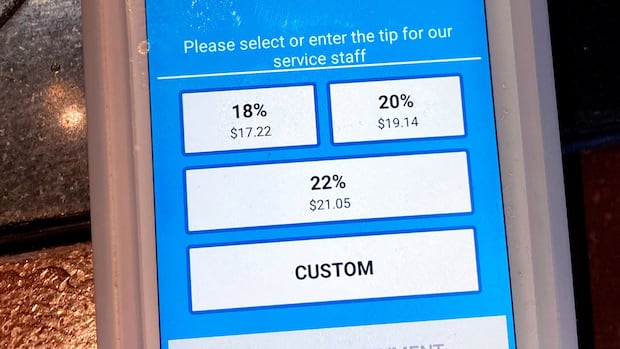
However, what might not be obvious when asked to tip your barista, hairstylist, or even your mechanic is that the calculation could be based on the entire amount, including tax.
In the past, leaving a tip often required some mental arithmetic, typically based on the subtotal prior to taxes.
Yet, with point-of-sale systems generating totals in an instant, it becomes challenging to understand how tipping calculations are made.
“Essentially, a consumer may need to use a calculator to verify whether it was calculated before or after tax, making it more complicated,” explained Sara Eve Levac, a lawyer with the Quebec-based non-profit organization Option Consommateurs, which advocates for consumers.

Sara Eve Levac from Option Consommateurs stated that the organization conducted focus groups on tipping with consumers nationwide, revealing that ‘people felt it was unclear’ whether tax was included. (Maude Desbois Photographie)
Responding to consumer concerns, Levac mentioned that their organization evaluated several restaurants and discovered instances where tips were indeed calculated after taxes.
Bonnie Simpson, a consumer behavior professor at Western University in London, Ontario, noted that in many scenarios where tipping is requested, we often do not receive itemized receipts that clearly differentiate between the total and the subtotal.
“We are presented with a small screen that does not provide a breakdown,” stated Simpson, who has studied consumer perspectives on tipping.
While it is true that most sit-down restaurants still provide a detailed paper receipt, many other tipping situations lead directly to the point-of-sale terminal.
Even when a receipt does show both the total before and after tax, it is not always clear which amount is used for calculating the tip.
Levac noted that Option Consommateurs hosted discussions with consumers across Canada, and the results indicated that “people felt it was unclear.”
In Quebec, new regulations established by Bill 72 last year prohibit any establishment from asking customers to tip on the total amount that includes tax.
The consumer protection office of the Quebec government informed CBC via email that it has received 988 complaints and issued 389 notices since these rules came into effect on May 7, 2025, with most complaints concerning restaurants, bars, and other food services.
Quebec remains the only province with specific guidelines governing how tips should be displayed on payment terminals.
Quebec’s justice minister has presented a bill requiring restaurants to calculate tips based on pre-tax prices to safeguard consumers from misleading tip suggestions.
The industry group Restaurants Canada issued a statement to CBC advising restaurants to “ensure that automated tip suggestions on payment terminals are based on the pre-tax amount and communicated clearly and impartially, enabling customers to make informed decisions that reflect their service experience.”
Is technology the culprit?
Levac mentioned that she has encountered reports from merchants claiming it is challenging to modify their payment terminals to calculate tips before tax.
However, when the research team at Option Consommateurs examined 12 popular payment systems, Levac stated they discovered that it was “actually quite straightforward for someone with basic technical knowledge to adjust the settings.”
Moneris and Square are among the most widely utilized payment processors in Canada, providing rental and sales of the payment terminals used by numerous Canadian businesses.
In correspondence with CBC, both companies stated that their devices can be customized, leaving it to businesses to determine how tips are calculated and whether to incorporate tax.
Is it time for a new approach?
In Edmonton, Sarah Burns expressed her appreciation for being able to enjoy coffee outings and occasional dinners, especially given the rising costs of living.
“However, I dislike tipping on the GST included in my bill,” she shared with Cost of Living.
“I would much rather see a European system where I believe servers receive a living wage.”

Professor Bonnie Simpson of Western University argues that tipping functions as a social contract we engage in as consumers, and achieving a new system may require significant consumer advocacy — and ultimately legislation. (Submitted by Bonnie Simpson)
Bonnie Simpson from Western University stated that tipping represents a social contract we uphold as consumers, emphasizing that substantial consumer pressure — and likely legislation — would be needed to establish a new system.
“Someone would need to conduct research and propose an alternative that still enables the hospitality industry to thrive while ensuring fair wages for workers. But implementing such a change would be considerable.”