
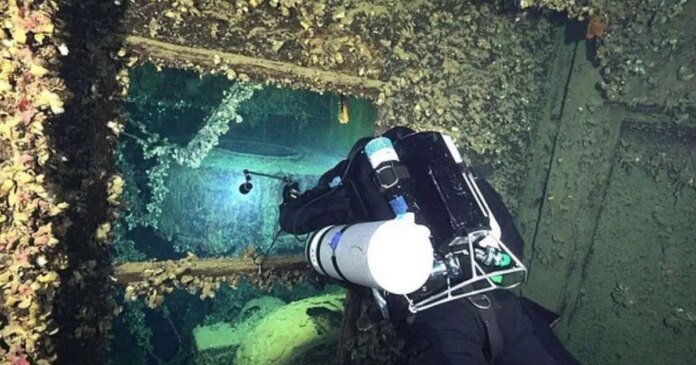

Archaeologists celebrated a significant discovery as valuable artifacts were retrieved from the sunken HMHS Britannic, often referred to as the ‘sister ship’ of the Titanic, more than a hundred years after its tragic demise. Originally built in 1914 as a luxury liner, the Britannic was repurposed as a hospital ship during World War I shortly after its construction. Unfortunately, just two years later, it struck a mine and sunk off the coast of Kea, near Athens, on its way to Lemnos, a Greek island.
Despite being the largest hospital ship in operation at the time, the Britannic disappeared beneath the waves within an hour. While all 1,060 passengers managed to escape, 30 individuals lost their lives when their lifeboats were struck by the ship’s propellers.
Recently, officials revealed that artifacts were successfully recovered from the Britannic wreck for the first time. Greece’s Culture Ministry reported that a specialized deep-sea diving team undertook a challenging week-long salvage operation in May to retrieve items from the wreckage. Among the findings were the ship’s bell, navigation light, and luxurious furnishings.
Divers faced difficult conditions, including strong currents and limited visibility, as they meticulously retrieved well-preserved artifacts such as silver-plated trays, ceramic tiles from a Turkish bath, and a porcelain sink believed to be from the second-class cabins. Notably, the sink maintained its original white finish, while a plate bearing the ‘White Star Line’ stamp and other items like a navigation lamp and passenger binoculars were also recovered.
The Britannic wreck remained untouched on the seabed until its discovery in 1975 by deep-sea explorer Jacques-Yves Cousteau. Found at a depth of 120 meters (400 feet), the site was accessible only to highly skilled divers. The recent recovery mission was a collaborative effort led by British historian Simon Mills, the Britannic Foundation’s founder. The retrieved artifacts have been transported to Athens for preservation.
These items are destined to become part of a permanent collection at the upcoming Museum of Underwater Antiquities in Piraeus, Greece. The museum, currently in development, will include a dedicated section showcasing First World War artifacts, with the Britannic items taking center stage.