
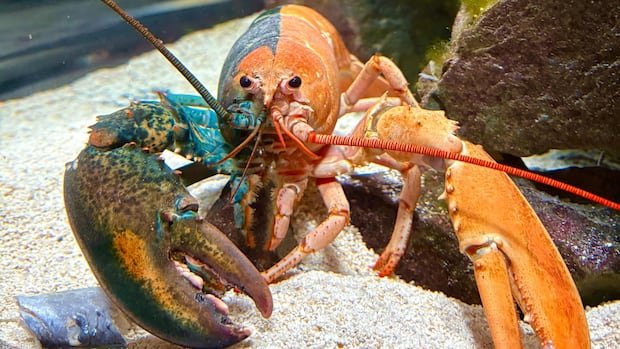

In his four decades as a lobster fisherman, Robert Wagner encountered a unique discovery: a lobster divided in color, with one half blue and the other half orange from head to tail. Wagner, amazed by the sight, named the lobster Oscar and felt fortunate to have come across such a rare find.
Oscar was found in one of the last traps on a day of fishing near Blue Rocks, located on Nova Scotia’s South Shore. Wagner, along with his family, took care of Oscar for a month before reaching out to Dalhousie University to offer Oscar a new home.
Nadia Stewart from Dalhousie’s Beaty Centre for Marine Biodiversity expressed gratitude for the opportunity to care for Oscar, stating that lobsters with distinct colorations like Oscar often face threats in the wild due to their visibility. Stewart mentioned that Oscar’s unique split coloration is a result of a rare genetic mutation, occurring in only one out of every 50 million lobsters.
After obtaining a special license, Wagner transported Oscar to Halifax. The lobster was acclimated to his new surroundings but surprised the staff by shedding his shell recently. The old blue-orange shell is now on display, and Oscar is taking a break to recover from the molting process.
Stewart mentioned that once Oscar’s new shell hardens, he will be back on display. Due to the genetic nature of Oscar’s coloration, his new shell is expected to also display the distinctive blue and orange hues.
Wagner expressed contentment with the decision to donate Oscar, stating, “We’re just grateful that it got in the right hands and hope [Oscar] has a good life.”