
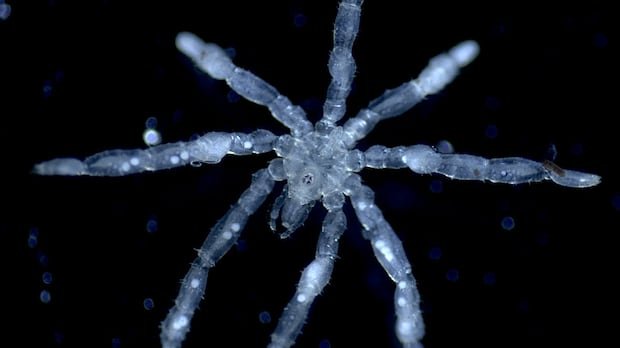

In the depths of the ocean, a peculiar creature with hairy legs and red eyes, reminiscent of a nightmarish monster, has been discovered by researchers in the Salish Sea region of southern British Columbia. These sea spiders, a distant relative of land spiders, have been found to be unique inhabitants of the marine environment, evolving separately from their terrestrial counterparts.
During a research expedition conducted between September 2023 and August 2024, led by Cormac Toller-Scott from the University of British Columbia, two previously unknown species of sea spiders were identified. The team explored various marine habitats in the area, including Quadra Island, Vancouver, Bamfield, and Victoria, diving up to 18 meters deep to collect samples.
Through detailed analysis of the creatures’ physical characteristics and genetic data, it was revealed that these new species reside on hydroids, marine organisms similar to attached jellyfish. They sustain themselves by consuming small pieces of the hydroids, essentially acting as parasites on the host organism.
The newly discovered sea spiders have been named Callipallene pilosuspedes and Tanystylum kiixin, with the former named after its hairy legs and the latter after an Indigenous village site close to where they were found. This discovery adds to the limited documented species of sea spiders in the Salish Sea and Vancouver Island region.
In a separate study by UBC researchers, a team led by biologist Shana Goffredi unearthed three new sea spider species living near methane seeps and hydrothermal vents on the ocean floor. These creatures displayed an extraordinary ability to cultivate bacteria that convert methane into essential nutrients, showcasing a unique ecological role in the marine ecosystem.
Despite the significance of taxonomic research projects like the sea spider study, they often receive inadequate funding. Toller-Scott emphasized the importance of taxonomy in laying the groundwork for broader scientific inquiries, suggesting that numerous undiscovered species may still exist along the diverse coastline of the West Coast of Canada.