
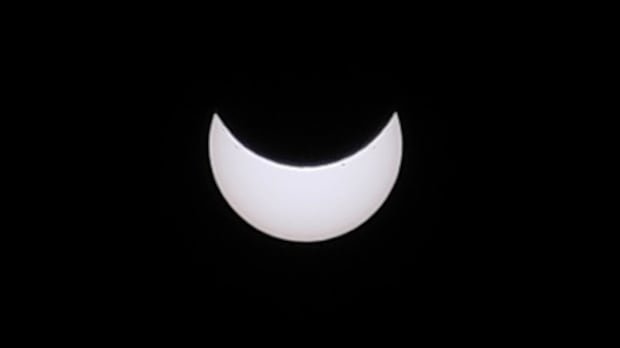

People in Newfoundland and Labrador had the opportunity to witness a partial solar eclipse on Wednesday afternoon, depending on the weather conditions. The partial eclipse was first visible in Churchill Falls at 1:37 AT (2:07 NT) and gradually spread across the province. The event concluded in St. John’s at 4:37 p.m. NT, with the moon covering around 50% of the sun in Newfoundland.
At the Johnson Geo Centre in St. John’s, a watch party, in collaboration with the Royal Astronomical Society of Canada and STEM Girls, observed the moon passing in front of the sun using special safety viewing glasses from 12 p.m. NT to 5 p.m. The excitement was palpable as spectators marveled at the celestial event.
Astronomer Hiding Neilson from Memorial University described the experience of watching the moon obscure the sun as fascinating. He emphasized the rarity of such events, with a partial eclipse occurring approximately every 50 years. Neilson highlighted the uniqueness of Earth’s solar eclipses compared to other planets in the solar system.
Andrea van Nostrand, the lead of education and interpretation at the Geo Centre, expressed the spectacular nature of the eclipse viewing experience, especially with the aid of special solar viewing tools and protective glasses. Meanwhile, a total solar eclipse was forecasted to be visible in Greenland, Iceland, Spain, and a small part of Portugal.
Following their experience observing a total eclipse two years ago, a mother-daughter duo, Jennifer Waye and Gabriela Fuentes Waye, traveled to Spain to witness the total solar eclipse from a different vantage point. The duo highlighted the beauty of such events and the anticipation of sharing the experience with a larger audience.
In Canada, regions farther north and east, such as Alert, Nunavut, were expected to witness a more complete solar eclipse, with the sun projected to be 94% covered. Overall, the celestial event captivated spectators and astronomy enthusiasts, offering a rare glimpse into the wonders of the universe.