
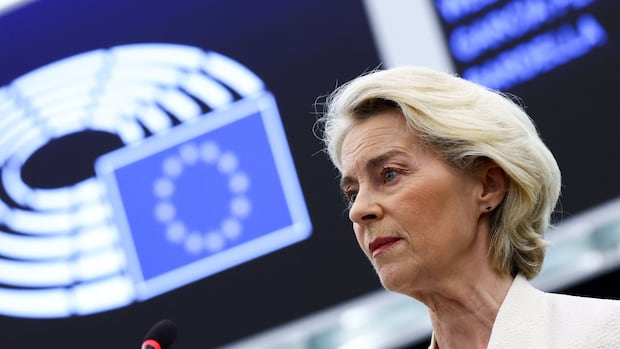

Ursula von der Leyen, President of the European Commission, announced that Europe is looking to establish a pathway for Canada to become an “associate member” of the European Union.
Prime Minister Mark Carney was present in the front row as von der Leyen outlined crucial elements for enhanced collaboration between Europe and Canada during her address in Strasbourg, France.
In her state of the union speech, she emphasized the necessity for both parties to “urgently reimagine” their partnership and to go beyond merely maintaining a free-trade agreement.
“I would like to collaborate with you on creating the opportunity for Canada to be the first associate member of the EU,” von der Leyen expressed on Wednesday, which elicited a standing ovation.
Carney acknowledged her remarks with a nod, stood up, approached von der Leyen, and warmly embraced her. He briefly acknowledged the audience before taking his seat again.
“We share one ocean, one set of values, and one perspective on the world,” she remarked. “And now we will also shape our shared future together — thank you for being present.”

European Commission President Ursula von der Leyen, after addressing the changing global landscape in her state of the European Union speech, highlighted the potential for the Canada-Europe relationship. ‘This is not a partnership against anyone else, but for our common strength.’
During his visit to France this week, Carney aims to strengthen ties with Europe, concentrating on trade, defense, and interpersonal connections.
In her speech, von der Leyen indicated that Europe seeks to elevate its relationship with Canada to the “highest level possible.”
The idea of an associate membership was mentioned last week when the Wall Street Journal reported, citing sources, that Canada was contemplating potential membership.
- Just Asking wants to know: What questions do you have about the EU and what “a unique alliance” with the bloc could look like for Canada? Send us your questions before our Sept. 19 show.
Carney expressed skepticism about the report on Sunday at the Toronto International Film Festival, clarifying that Canada was not pursuing EU membership but rather aiming for a “unique alliance” with the bloc.
He is scheduled to give a speech at the European Parliament on Thursday, following an invitation from European Parliament President Roberta Metsola.

Prime Minister Mark Carney has indicated that Canada is ‘not looking to be a member of the European Union.’ But if we did want to join the EU, is that even possible? Here are the facts.
Carney received a warm welcome earlier on Wednesday at the European Parliament, where he was greeted by Metsola and von der Leyen.
As he entered the chamber, he was met with applause and received a standing ovation following his formal introduction by Metsola.
“Mark, your presence here symbolizes the lasting friendship between our nations,” von der Leyen stated in her speech, which lasted over an hour. “Our cultural, historical, and personal ties are deeply woven into the fabric of our societies.
“We view the world similarly: from AI to climate change, from the Arctic to geopolitical issues. We have stood united on Ukraine, defense, raw materials, and supply chains.”
Von der Leyen remarked that Europe and Canada would transition from a free trade agreement to “an alliance for the future,” enhancing cooperation on the Arctic, energy, critical minerals, and battery technologies.
EU representative downplays ‘associate’ term
The Prime Minister’s Office did not clarify the proposal regarding Canada’s potential associate membership in the EU but focused instead on von der Leyen’s other comments about forming a partnership.
“We appreciate President von der Leyen’s proposal for Canada and the European Union to move beyond the [free trade agreement] toward an alliance for the future,” a spokesperson stated.
“This is a unique, positive approach that we will define collaboratively.”
- Just Asking wants to know: What questions do you have about the EU and what “a unique alliance” with the bloc could look like for Canada? Send us your questions before our September 19 show.
The term “associate member” lacks a legal basis within the EU, and the bloc’s regulations stipulate that only European nations may apply for membership.
Jonathan Wilkinson, who is set to be Canada’s ambassador to the EU, downplayed von der Leyen’s suggestion, noting that both sides are “a ways away” from agreeing on a description for a prospective relationship.

Jonathan Wilkinson, Canada’s incoming ambassador to the European Union, states that ‘we’re not there’ after European Commission President Ursula von der Leyen proposed the possibility of associate membership. ‘What we’re focused on is actually driving results,’ he noted, adding that the government will ‘eventually’ address how to characterize the relationship.
“Various terms have been used to describe what this could entail. I believe we need to reach a point where we have a clear understanding of what we are describing,” Wilkinson told reporters following von der Leyen’s address.
“It’s about nomenclature; ultimately, there are many ways to articulate it.”
Wilkinson reiterated that Canada is “not seeking to become a member of the European Union.”
Conservative Leader Pierre Poilievre criticized Carney, stating he “can’t seem to get his story straight” after von der Leyen mentioned the “associated membership” concept in her speech.
“Conservatives are clear: we endorse the long-standing free trade and NATO defense alliance with Europe,” he commented on X.
“However, no EU taxes, no EU laws, and no EU open-border immigration policies should be imposed on Canadians.”
The initial report by the Wall Street Journal led to a strong backlash from Poilievre, who remarked on social media that Carney “could not be more out of touch.”
“We will NEVER be the 51st U.S. state,” Poilievre asserted. “And we will NEVER be the 28th EU state.”

Prime Minister Mark Carney attends the State of the European Union address in Strasbourg, France, on Wednesday. (Justin Tang/The Canadian Press)
After von der Leyen’s speech, Carney remained in the chamber for over an hour, listening to addresses from other political leaders.
Terry Reintke, the leader of the Greens-European Free Alliance group in the European Parliament, which holds seven percent of the seats, began her comments by expressing her hopes to see Carney back in the chamber in the future.
“You are very welcome in this house. I hope you are already feeling at home among the member states here, as we look forward to seeing you often,” Reintke stated.
- This week Cross Country Checkup is asking: Is Canada’s future with the United States or Europe? What’s at stake for you if Canada builds closer relations with the European Union? Leave your comment here and we may read it or call you back for Sunday’s show.
Thomas Byrne, Ireland’s minister of state for European affairs, sat next to Carney throughout the morning.
He began his remarks by reflecting on their shared heritage, noting that their grandfathers hailed from the same Irish county, both having served in the Irish police force.
“Your presence here today is a visible representation of the profound bond between the European Union and Canada,” Byrne remarked.
“Thank you, President von der Leyen. Your proposal greatly enhances the relationship between the European Union and our esteemed friend, Canada.”