
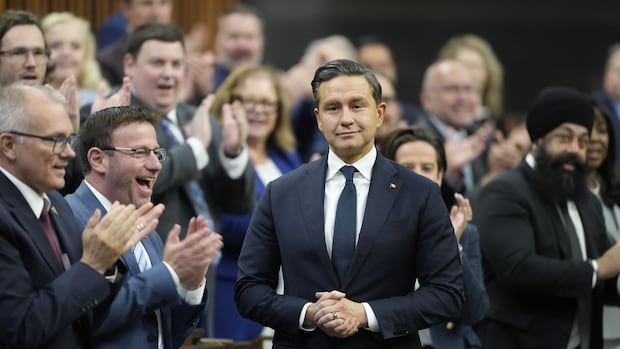

As Members of Parliament prepare to reconvene in Ottawa on Monday, the federal Conservative Party finds itself in the role of Opposition, attempting to carve out relevance in a national dialogue heavily influenced by U.S. President Donald Trump’s trade conflict with Canada and the public’s focus on Prime Minister Mark Carney’s interactions with the White House.
The leader of the Official Opposition provided a glimpse of his approach during a press conference held prior to his caucus meeting in Penticton, B.C.
Pierre Poilievre remarked in Vancouver on Tuesday, “The hope that Canada represents — that hard work leads to a prosperous life, home ownership, affordable food, and safe neighborhoods — has been shattered after 11 years of Liberal governance.”
His emphasis was on issues of affordability, a strategy that had proven effective when Justin Trudeau was still Prime Minister.
However, pollster David Coletto suggests that Canadians are currently reluctant to assign the blame for soaring prices to Carney.
“It’s not a direct accusation towards Ottawa or Mr. Carney; the focus is on Donald Trump,” explained Coletto, CEO of Abacus Data.
Recently, Poilievre has shown an increasing awareness of Trump’s significant influence over the Canadian public.
He made a trip to New York, where he appeared on both Fox Business and CNBC.

In an appearance on CNBC’s Squawk Box, Conservative Leader Pierre Poilievre stated he would not attack his prime minister while abroad, amidst the ongoing trade turmoil. He noted that Canadians are feeling ‘wounded’ and ‘confused’ regarding how their economy became a target for U.S. President Donald Trump.
However, acknowledging the complexity of the situation is one thing; discovering an effective response is quite another.
“How do you maintain relevance when many Canadians perceive the largest threats to their lives as stemming from the United States, and when they largely believe the prime minister and the Liberal Party are better equipped to address those threats?” Coletto pondered.
Coletto, who carefully monitored the Conservatives’ previous ascent in public opinion before it dwindled during the 2025 federal election, stated that the Official Opposition is now facing its lowest polling figures in nearly a decade, with the Liberals leading by 14 points.
“It’s about effectively managing the differing voices within your party, including those who may not want to align with Team Canada or are uncomfortable with certain Liberal actions,” he noted.
‘Difficult’ discussions welcomed: Conservative MP
Recently, party commentators expressed surprise when Poilievre’s MP, Jamil Jivani, publicly advocated for a less confrontational approach in relations with the U.S.
“There’s an immediate atmosphere where Canadians who disagree with Liberal policies are labeled as traitors, while those who should present alternatives to Liberals are instead attempting to appease the powerful,” Jivani stated while sitting in front of a Canadian flag in a video posted on his social media.
As a former university roommate of U.S. Vice-President JD Vance, Jivani likened the Liberals’ trade war strategy to their relatively unchallenged management of the COVID-19 pandemic, while pushing for improved relations with the U.S.
“We need you to remain steadfast, uphold your resolve, and resist the pressure to believe there’s only one solution to our nation’s challenges,” he urged.
While he did not explicitly name Poilievre, the implication was evident to Dimitri Soudas, who once served as spokesperson for former Conservative Prime Minister Stephen Harper.
“Not a single word criticizing Donald Trump, nor a compliment towards Pierre Poilievre. Sometimes, what a politician chooses not to express can be more telling than anything else,” Soudas shared on X.
Former Alberta Premier Jason Kenney, who was in Harper’s cabinet alongside Poilievre, shared a similar interpretation of the situation.
-
Stephen Harper says Canada had ‘no choice’ but to walk away from U.S. trade talks
-
Poilievre says he’ll campaign to keep Alberta in the ‘Canadian family’ as a referendum looms
-
Federal Tories launch ‘Conservatives for Canada’ campaign ahead of Alberta referendum
“[Jivani] attempts to overshadow Pierre’s significant trip by posting a self-serving video positioning himself as a martyr, without any acknowledgment of his leader’s endeavors,” Kenney commented on X.
However, if there is a strategy to address Jivani’s comments, Poilievre did not disclose it on Tuesday.
“The party embraces a variety of perspectives from across the nation,” stated the party’s industry critic, Adam Chambers, in an interview with CBC News prior to the caucus meeting.
“If you’re not engaging in challenging discussions as a party… then I don’t believe you’re having the right dialogue.”
Coletto indicated that “not reining [Jivani] in” is a method to “navigate the diversity and intricacies” of the Conservative coalition. Nonetheless, he also noted that it highlights “the quandary Mr. Poilievre faces regarding the Trump issue in Canada.”
Compounding this complexity, later on Tuesday, Harper, who previously endorsed both Poilievre’s leadership bid in 2022 and election campaign last year, was in Toronto concluding an investment summit hosted by Carney.
Harper acknowledged that it “must have been a very challenging decision” for Carney to exit the trade discussions with the U.S., but he asserted that it was the only viable option. He also commended the federal government for expediting significant project approvals and expressed optimism about its efforts to reduce reliance on the U.S.

Stephen Harper, the last federal Conservative leader to successfully form a government, addressed Prime Minister Mark Carney’s investment summit on Tuesday. (Nathan Denette/The Canadian Press)
When asked whether the presence of the only modern Conservative prime minister at Carney’s event undermined his message, Poilievre responded that “it does not,” and mentioned that he had conversed with his party’s former leader a few days earlier.
“Naturally, Conservatives will always prioritize Canada, and we are open to collaborating with anyone,” he stated.
Yet, as further challenges arise for the movement, uncertainties linger regarding who will align with him.
Upcoming separation vote
In British Columbia, the provincial Conservative Party has been losing MLAs, paralleling the trend of federal MPs who have departed from Poilievre’s ranks over the past year.
Additionally, a referendum in Alberta is approaching in just over a month, during which voters will decide whether they want to remain part of Canada or consider a future vote on secession.
Unlike Carney, Poilievre has already delivered two significant speeches in Alberta advocating for unity. However, unlike Carney, he must contemplate his party’s power base in the province. Polling from Coletto indicates that nearly half of Conservative voters in Alberta sympathize with the separatist viewpoint.
“If he aspires to be the prime minister of Canada, he cannot be perceived as a separatist,” Coletto remarked.
Poilievre’s provincial counterpart, Alberta Premier Danielle Smith, may have already experienced the repercussions of voters viewing a political party as too aligned with the sovereignty movement, as evidenced by the Alberta NDP securing a seat in a historically conservative Calgary riding during a recent byelection this week.
This presents yet another challenge for Poilievre’s coalition during a fall session where the agenda threatens to overshadow his party.