
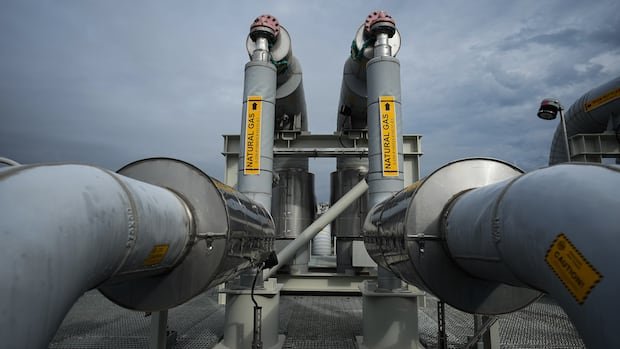

Prime Minister Mark Carney recently emphasized the vital role of Canadian natural gas in driving American economic growth. Speculation arises on the potential repercussions if Canada were to halt its natural gas exports to the United States amid escalating trade tensions.
While energy commodities like oil and natural gas have not been utilized as bargaining tools in the ongoing Canada-U.S. trade conflict, opinions on this strategy vary. Alberta Premier Danielle Smith has consistently opposed such actions, contrasting with Ontario’s Doug Ford, who advocates considering all available options.
In a post-trade talk breakdown speech, Carney highlighted the significance of Canadian energy supplies to the U.S., stating that Canada serves as a major contributor, providing 99% of the U.S.’s natural gas imports, 85% of electricity imports, and 60% of crude oil imports.
Although the U.S. heavily relies on Canada for its natural gas imports, constituting nearly all non-domestic supply as per the U.S. Energy Information Administration, this only represents a fraction (about 8%) of the total U.S. natural gas consumption.
Dulles Wang, the director of Americas gas and LNG at Wood Mackenzie, indicated that Canadian natural gas deliveries to the U.S. account for a small percentage, around 5%, according to the firm’s estimates. The intricate network of natural gas pipelines between Canada and the U.S. plays a critical role in supplying energy for residential, industrial, and commercial purposes.
Enbridge, a prominent Calgary-based company, stands as North America’s largest natural gas provider. The company recently completed a series of acquisitions totaling $19 billion, expanding its reach and influence in the industry.
Despite the relatively modest scale of Canadian natural gas exports to the U.S. compared to domestic production, Wang stresses the geographical significance of these deliveries. While certain regions in the U.S. boast self-sufficiency in natural gas production like Texas, areas such as the Pacific Northwest heavily rely on Canadian imports for over 90% of their gas consumption.
Driven by the growing demand for artificial intelligence, regions like the Pacific Northwest witness a surge in data center construction, fueled by major tech companies such as Amazon, Google, Microsoft, and Meta. These facilities heavily depend on natural gas as a primary power source to complement renewable energy sources.
Halting natural gas exports to the U.S. could have severe repercussions for Canada’s energy sector, leading to an oversupply situation and plummeting prices. Wang warns that such a move could significantly impact Canada’s economy, eliminating a crucial market and causing a price crash with no clear winner in the scenario.
To diversify its energy market and reduce reliance on the U.S., Canada has started exploring new markets, with LNG exports to Asian markets from facilities like LNG Canada in Kitimat, B.C. The government’s support for these projects reflects its commitment to expanding Canada’s energy export portfolio beyond traditional markets.