
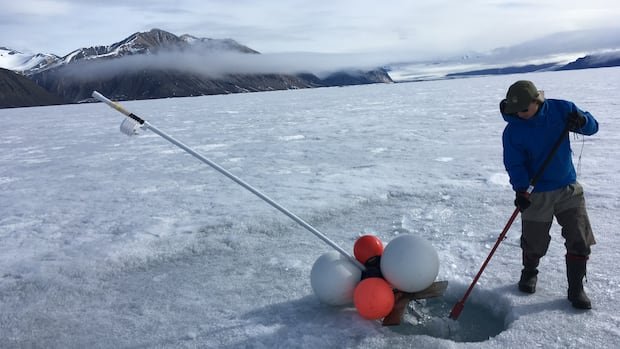

Canada’s solitary remaining epishelf lake, characterized by freshwater floating atop saltwater, has vanished, along with the distinctive ecosystem it sustained, as per findings by scientists in a recent study. Jérémie Bonneau, the study’s principal researcher and an assistant professor at Laval University in Quebec City, expressed sorrow over the loss, emphasizing the uniqueness of the Milne Fiord epishelf lake on Ellesmere Island in Nunavut, labeling it as “the last thing like that in Canada.”
The sudden disappearance of this once prevalent phenomenon underscores the impact of a warming climate on the Arctic. While earlier reports had mentioned the demise of the lake, the latest study, published in the journal Scientific Reports, provides a detailed account of the process leading to its disappearance, describing the irreversible loss as marking a significant shift and the conclusion of a 4000-year era.
The formation of epishelf lakes involves glaciers, which act as icy rivers flowing into the sea, along with any surface meltwater. The Milne Fiord’s mouth had been obstructed for millennia by the Milne Ice Shelf, preventing freshwater from mingling with the ocean and allowing it to accumulate above the Arctic Ocean’s saltwater. This resulted in the creation of a floating freshwater layer, owing to the lower density of freshwater compared to saltwater.
Furthermore, a perennial ice layer of about 50 to 100 centimeters covered the lake, shielding the freshwater and saltwater layers from winds that could have mixed them, rendering the lake imperceptible from the surface. Researchers found evidence suggesting the existence and accumulation of freshwater in the Milne Fiord lake for over 4000 years.
The Milne Fiord epishelf lake, unlike some counterparts that are entirely situated on an ice shelf, was connected to the ocean through an under-ice channel in the ice shelf, which had been diminishing for around a century.
The lake harbored distinct ecosystems in its freshwater and saltwater layers, with minimal overlap in the microbial communities residing just 20 centimeters apart. The disappearance of the lake due to the break-up of the Milne Ice Shelf in 2020 led to the immediate demise of freshwater organisms upon mixing with seawater.
While epishelf lakes have vanished from Canada, a few still persist in Greenland and Antarctica. However, researchers express concerns about their future, emphasizing the irreversible loss of unique ecosystems due to the changing climate.