
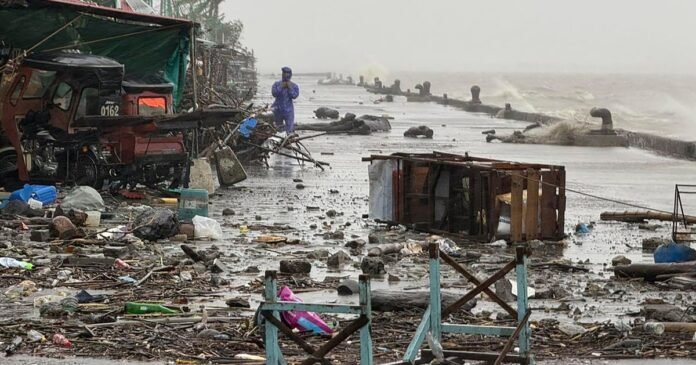

Tens of thousands of individuals have been relocated in the Philippines following the arrival of a powerful typhoon.
Super Typhoon Ragasa, also known as Nando locally, struck the northern region of the country with intense winds reaching 270kmph (167mph). Over 10,000 residents were instructed to evacuate their residences and move to designated shelters and schools due to the turbulent weather conditions.
As meteorologists issued a life-threatening warning, businesses were compelled to shut down operations. The World Meteorological Center in Beijing cautioned that Vietnam, Laos, and Cambodia might encounter exceptionally heavy rainfall. Forecasters also highlighted that the Bashi Channel, northern South China Sea, and Beibu Gulf were at risk of strong winds. Southern India, Bangladesh, Myanmar, and Thailand were expected to be impacted as well.
Numerous airlines, including Cathay Pacific, cautioned travelers about potential disruptions, with the airline preparing to cancel around 500 flights. Cathay Pacific announced a temporary halt in passenger flights to and from Hong Kong International Airport due to the impending storm.
Government officials have urged citizens nationwide to exercise caution in light of the situation. The Philippines Department of the Interior and Local Government emphasized the importance of safety measures, emphasizing that while property can be rebuilt, lost lives are irreplaceable.
Typhoon Ragasa is anticipated to bring severe winds to the South China Sea and neighboring regions, as per expert warnings. The World Meteorological Center in Beijing highlighted the expected heavy to torrential rain in various areas, including the Philippines, Vietnam, Laos, and Cambodia, with potential gales in the Bashi Channel, northern South China Sea, and Beibu Gulf.
Residents in a specific province have been witnessing a rare meteorological phenomenon known as the “stadium effect.” Hurricane historian Michael Ferragamo noted that individuals on Babuyan Island, Cagayan, were experiencing a unique event, describing it as a once-in-a-lifetime occurrence.
A video captured the destructive winds wreaking havoc on homes in Cagayan, showing trees swaying amidst heavy rainfall, obscuring visibility. The weather conditions were severe, with no clear view of the surroundings due to the intense storm.
Cathay Pacific’s flight operations are anticipated to be significantly impacted, with more than 500 flights expected to be canceled. The airline expressed concerns over the storm severity, leading to the necessary flight interruptions.
Authorities in the Philippines provided an overview of potential impacts in the capital, Manila, warning of heavy rainfall and potential localized flooding. The Philippine Atmospheric, Geophysical and Astronomical Services Administration highlighted various expected consequences, including potential damage to health facilities, minor injuries, and disruptions in transportation services.
Qantas also alerted customers about potential travel disruptions in Hong Kong due to Typhoon Ragasa, indicating possible flight delays and cancellations during specific hours. The airline emphasized customer safety as a top priority and advised passengers to stay updated on flight statuses through their official channels.
A striking satellite image depicted the magnitude of Typhoon Ragasa, showcasing the storm’s intensity as it continued to affect the Philippines. The weather agency in the Philippines raised concerns about coastal inundation, particularly in northern provinces, emphasizing the risk of life-threatening storm surges.
Over 10,000 individuals were evacuated from their residences in the morning, with schools and offices closed in the Philippines and Taiwan to mitigate the risks associated with one of the most powerful typhoons of the year.