


A unique porcelain “breast bowl” commissioned by Louis XVI for Marie-Antoinette in the 18th century fetched approximately $4.5 million in Paris on Thursday.
This unusually shaped drinking vessel, referred to as a jatte-téton, is a fine porcelain piece designed to resemble a woman’s breast, complete with a rosy pink nipple, and rests on a tripod adorned with intricate foliage and three goat heads.
It was sold for 2.925 million euros through the French auction house Coutau-Bégarie, achieving a record price for a Sèvres piece at auction — the renowned porcelain maker favored by European royalty during the late 18th and early 19th centuries.
Once thought to be lost, the bowl was discovered unexpectedly in a crate at Galerie Meyer in Paris, as reported by the auction house l’Hôtel Drouot in a social media post celebrating the historic sale.
Auction organizers had anticipated the selling price would range between one and two million euros (roughly $1.5 million to $3.1 million).
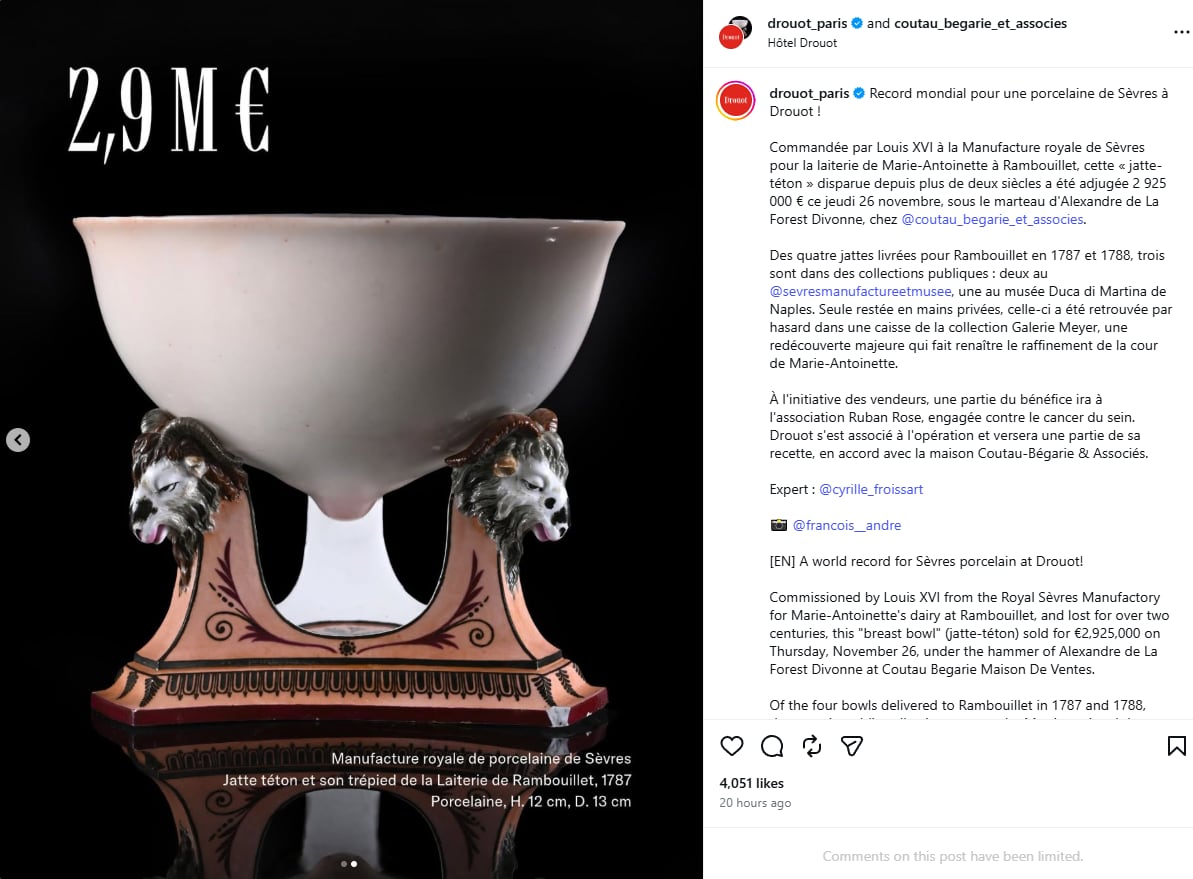
The French auction house l’Hôtel Drouot highlighted the record price on social media. Three additional breast bowls from the original set are housed in public collections. (Hôtel Drouot/Instagram)
The buyer’s identity remains confidential.
Funds raised from Thursday’s auction will support breast cancer research, with portions of the proceeds designated for the French non-profit l’Association Ruban Rose by the seller, the auctioneer, and the venue.
Designed for ‘pleasure dairy’
Marie-Antoinette was not particularly fond of the Rambouillet estate, located southwest of Paris, when Louis acquired it. To persuade her, the king constructed an opulent “pleasure dairy” on the property where she could host nobles and indulge in delights such as fresh milk, cheeses, and ice cream.
As part of this extravagant gift, he instructed Sèvres artisans to create an exquisite collection of porcelain serving pieces — including a set of four jatte-téton, inspired by mastos, the Greek breast-shaped drinking vessels used during feasts.
While there is a popular myth that the shape was modeled after Marie-Antoinette’s own breast, experts from Sèvres have dismissed this claim.
The remaining three breast bowls from the Rambouillet collection are displayed at France’s National Ceramics Museum in Sèvres and the Duca di Martina Museum in Naples.