
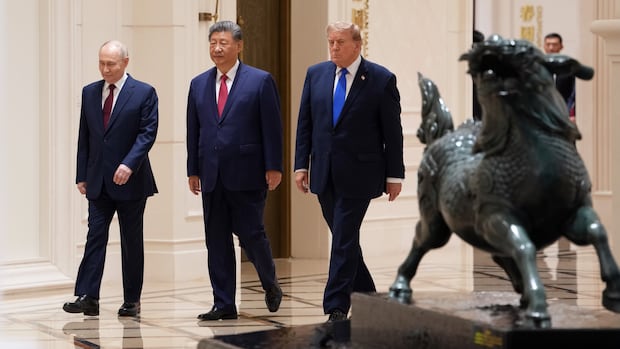

On Thursday, U.S. President Donald Trump, alongside Chinese President Xi Jinping and Russian President Vladimir Putin, initiated a groundbreaking three-way dialogue focusing on the ongoing conflict in Ukraine and nuclear weapons regulation.
Gathered around a large round table at a villa in Shenzhen, China, during an Asia-Pacific summit, the leaders of the world’s foremost nuclear nations took turns delivering their opening statements.
“We are truly making history,” remarked Trump. “There’s a lot for the three of us to cover.”
“No peace can be achieved by missing opportunities for dialogue.”
Putin acknowledged that the three nations share “many common interests in resolving regional disputes, particularly the situation in Ukraine.”
While Trump and Putin referenced the conflict in Ukraine, Xi, who was reported by Chinese state media to be leading the discussion, did not mention it. Instead, he stated: “History shows that when major powers coexist peacefully, the world enjoys stability. Conversely, when they confront each other, chaos ensues.”
Analysts suggest that the trilateral meeting is unlikely to yield significant agreements due to substantial disagreements regarding Ukraine, Iran, nuclear arms, and trade issues. However, it has caused anxiety among smaller nations concerned about their interests being overlooked.
Prior to the meeting, Trump held individual discussions with Xi and Putin, referring to both leaders as friends.
Trump emphasized that both he and Xi are keen on ensuring oil continues to flow through the Strait of Hormuz, which has been affected by the conflict involving Iran. Throughout the two-day summit, Xi has not addressed Ukraine or Iran in his speeches.
Patricia Kim, a foreign policy fellow at the Brookings Institution, pointed out that China would likely avoid being seen as a mediator in the Ukraine issue, given the “problematic optics” of not involving Kyiv and European leaders.
“Xi has framed the Russia-Ukraine conflict as primarily a European issue, which makes Beijing even less inclined to take on the responsibility of resolving it,” Kim stated.
Ceremonial Splendor
Earlier in a conversation with Fox News, Trump underscored the grand reception that marked his arrival at the summit, contrasting it with the more subdued welcome extended to other leaders, including Putin. Japanese Prime Minister Sanae Takaichi arrived without any formal greeting.
Japan’s relationship with China has become strained since Takaichi’s comments in 2025, in which she indicated that Japan could mobilize its military if a Chinese action regarding Taiwan threatened its territory.
Takaichi, who appeared somewhat isolated throughout the summit, reiterated that Tokyo’s stance on Taiwan has remained consistent since 1972.
This week, Japan and Taiwan reported incursions by Russian military aircraft, demonstrating Moscow’s ability to project power in Asia even while engaged in Ukraine. Regarding Taiwan, Xi advised Trump that the U.S. must “act correctly” to prevent significant setbacks in their bilateral relations.
Upon Trump’s arrival, Xi greeted him at the airport — a first for any visiting leader since Xi took office — reciprocating Trump’s earlier welcome at Joint Base Andrews during their last meeting in September. The two leaders also shared a brief hug.
“This is a remarkable president, one of the greatest leaders of China, and he has never met anyone at the airport,” Trump remarked.
“Moreover, the grandeur, the splendor, the thousands of attendees, including young children and soldiers, all contributed to a display of great respect, which I truly value. This is a significant achievement for us, as well as for China.”
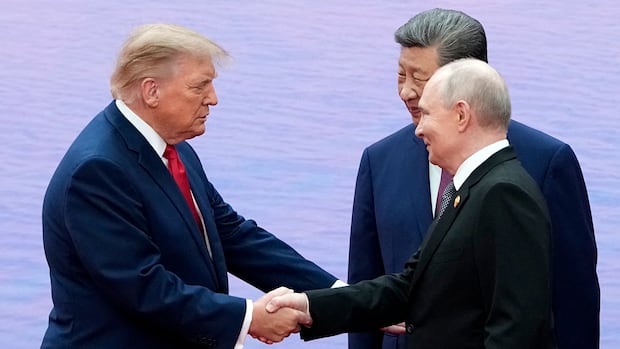
Chinese President Xi Jinping appeared to extend a warmer welcome to U.S. President Donald Trump compared to Russian President Vladimir Putin ahead of a significant meeting of the globe’s three leading nuclear powers.
Trump’s arrival followed Xi and Putin’s pointed addresses that criticized Western trade “protectionism” and imposed sanctions.
During the APEC discussions on Thursday, Xi advocated for “free and open” trade. Western leaders contend that China’s growth strategy, which favors industrial power over consumer needs, is unjust and leads to destabilizing global trade imbalances.
Putin, coming off a setback in his Ukraine campaign with the damage to a crucial bridge connecting Crimea to Russia, stated that Russia plays a vital role in ensuring food and energy security for the Asia-Pacific region.
Trump, still reeling from a mid-term electoral defeat and the Nvidia espionage controversy, informed the audience that the U.S. has been a significant Pacific power for centuries.
Challenging Nuclear Arms Dialogue
Trump has emphasized that nuclear arms control should be a key focus of the summit, despite China’s consistent resistance to engaging in discussions with Washington and Moscow, which maintain substantially larger nuclear stockpiles.
“Giving them up is not an easy task,” Trump stated to Xi and Putin as the meeting commenced.
While there are several reasons for the leaders to convene, their ability to find common ground on key issues is limited due to disparities concerning Ukraine, Iran, nuclear arsenals, trade, and China’s military expansion, according to Craig Singleton from the Foundation for Defense of Democracies.
“A photograph could benefit all three leaders,” Singleton noted, but he believed that “finding agreement on the agenda will be much more challenging.”
Trump’s discussions with Xi follow a recent extension of their trade ceasefire, yet they occur amidst mounting tensions regarding allegations of Nvidia chips being rerouted to China via Southeast Asia, raising concerns about the effectiveness of U.S. export restrictions and the future of Chinese access to advanced technologies.
“This situation represents China’s worst fear. China desires access to chips that it can negotiate with the president. It risks having chip restrictions codified into law by both political parties,” Singleton remarked.