


Kimberly Prost quickly began to experience the repercussions of the U.S. sanctions.
“These economic sanctions are significant in every aspect,” remarked Prost, a Canadian jurist at the International Criminal Court (ICC), who was sanctioned by the Trump administration last year.
She noted that her credit cards had been revoked and her banking access severely restricted due to the extensive influence the U.S. holds over the global financial system.
“Each time I attempt to make a bank transfer, I feel a sense of anxiety because I can’t predict whether it will go through,” Prost explained in a discussion with CBC News.
“Whether it’s ordering an Uber, reserving a hotel, or purchasing a theatre ticket, nearly everything necessitates a credit card, and adapting to this situation has been challenging.”

Located in The Hague, Netherlands, the ICC is tasked with investigating and prosecuting individuals accused of genocide, war crimes, and crimes against humanity when courts in its 125 member countries, including Canada, are either unwilling or unable to take action.
The sanctions imposed on Prost are part of a broader U.S. initiative aimed at undermining and dismantling the ICC, which gained momentum following a February 2025 executive order that established sanctions against the court for probing American personnel and issuing arrest warrants for Israeli Prime Minister Benjamin Netanyahu and his former defense minister Yoav Gallant.
U.S. President Donald Trump has continued his assault on the international court, urging member nations to promptly “withdraw from this rogue institution” during a speech at the UN General Assembly in September. Most recently, Secretary of State Marco Rubio threatened to dismantle the ICC “brick by brick” if allied nations do not “curtail” the court’s activities.
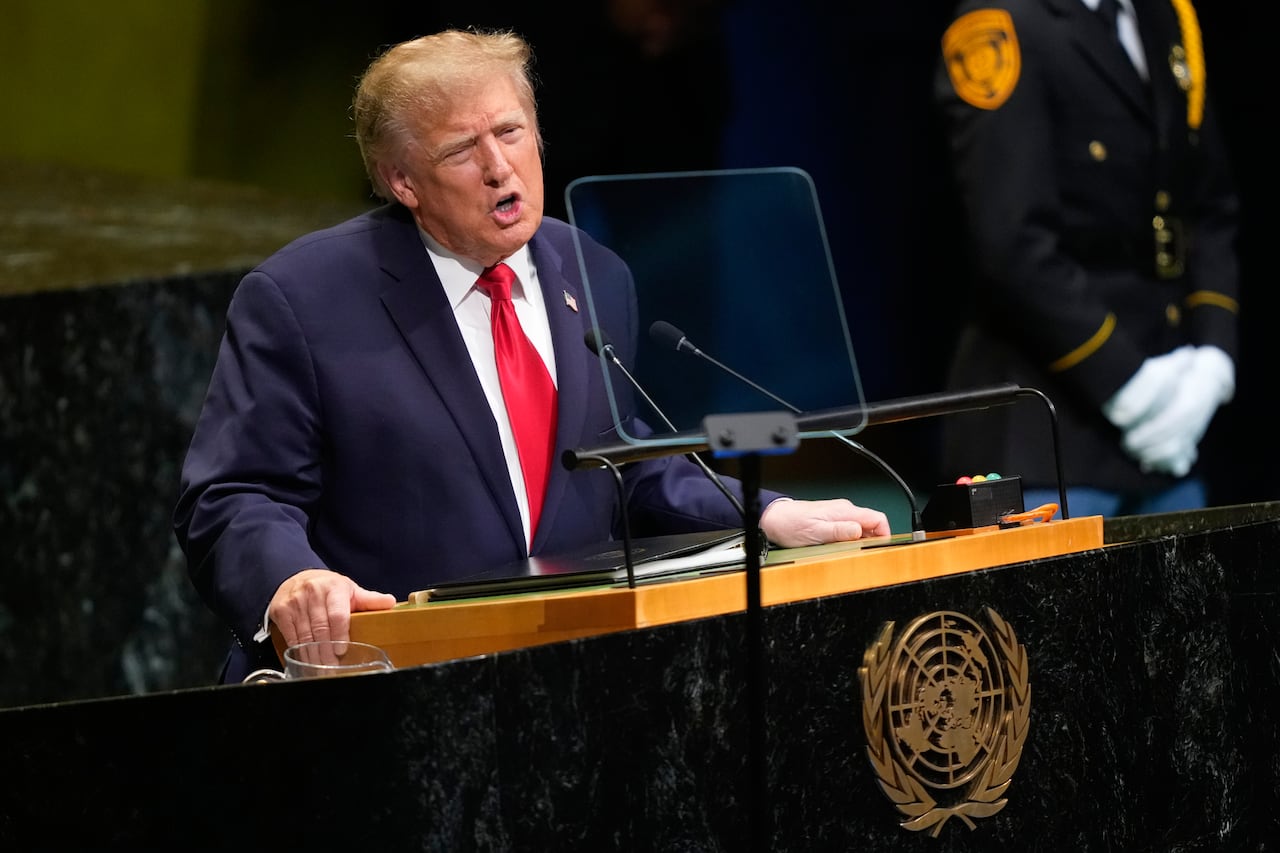
In a speech delivered on September 22, 2026, at the United Nations General Assembly, U.S. President Donald Trump urged member states of the International Criminal Court to ‘officially resign from this rogue institution immediately.’ (Yuki Iwamura/The Associated Press)
Prost claims that these actions are an assault on the international criminal justice system and the rule of law that has been established since World War II.
“It represents an assault on a world where victims of atrocity crimes are neglected. It supports impunity and the cessation of accountability for such crimes. That is the only way to view it.”
Rubio asserts ICC jeopardizes Americans
Prost was specifically targeted for her involvement in authorizing a preliminary investigation in March 2020 into alleged war crimes in Afghanistan dating back to 2003, which included actions by U.S. military personnel.
However, since 2021, the focus of the investigation has shifted away from the U.S., now concentrating on the Afghan government and Taliban forces.
“To my knowledge, there is no ongoing investigation concerning the Americans in this case, yet I am sanctioned.”
The United States has never joined the ICC and has consistently voiced concerns that its citizens could face prosecution.
“As the United States endeavors to foster peace globally, our diplomats or soldiers could find themselves drawn into this court,” President George W. Bush stated the day after the court’s establishment in 2002. “This is deeply concerning to me.”
Twenty-four years later, Rubio reiterated similar concerns regarding the “threats” posed by the global court, warning that American border patrol agents, marines, and prosecutors would “be subjected to the whims of foreign judges,” risking incarceration for defending their nation.
However, Prost contends that Rubio’s claims are misleading, asserting that the ICC would hold “no jurisdiction” if the U.S. asserted its sovereignty and conducted its own legitimate investigations or prosecutions when allegations arise.
Member nations ‘must safeguard’ the ICC
Prost and two other ICC judges filed a lawsuit against the Trump administration in June, challenging the sanctions they assert are “meant to apply extra-judicial pressure” and coerce them into “favoring their personal interests over adjudicating cases based on the law and evidence.”
“We concluded that it was so critical and such an obstruction to our work — and to the court’s work — that we needed to contest it in the U.S. courts,” stated Prost.
In July, four former U.S. ambassadors and prosecutors from international criminal tribunals submitted a brief supporting the ICC judges, arguing that the sanctions “punish independent judicial decision-making.”
Canadian officials have not intervened in Prost’s legal action. However, in a September interview with CBC News, Foreign Minister Anita Anand stated that Canada “remains dedicated to the ICC process.”
“As a sovereign nation, we shape our foreign policy, which includes the principles that guide it,” Anand remarked. “One of those core principles is adherence to international law.”
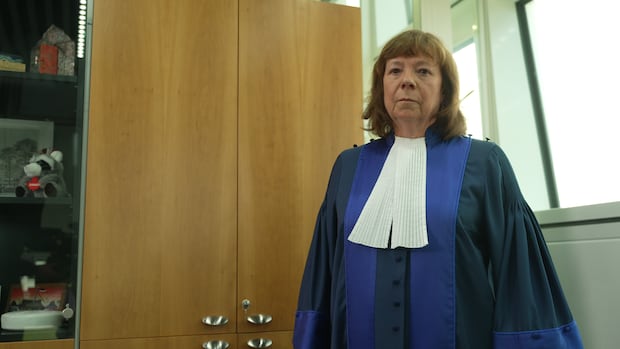
In spite of the economic sanctions imposed on her by the U.S., International Criminal Court Judge Kimberly Prost asserts she would ‘never think about abandoning’ her mission to deliver justice for victims of atrocity crimes.
Prost indicated that attempts to intimidate her and her fellow judges are ultimately “ineffective.”
“We will continue to evaluate our cases based on the facts, the law, and the evidence available to us in an objective and independent manner, and that will not change,” she affirmed.
In October, the U.S. permitted the ICC to utilize specific information technology and banking services for six months. The State Department stated that this period would allow member nations to showcase “substantial progress” on U.S. concerns.
-
EU awards human rights prize to International Criminal Court amid Trump attacks
-
Trump administration hits International Criminal Court with sweeping sanctions
Prost mentioned that losing access to these systems might have a “severely detrimental impact” on the court’s functionality.
While some member countries have shown support, she emphasized that the current moment is “critically important” for protecting the ICC, which has begun preparations in case the sanctions are fully enforced.
“This court belongs to the states. It is not the court of the prosecutors or the judges. It is the court of the states, and they must take steps to safeguard it.”