
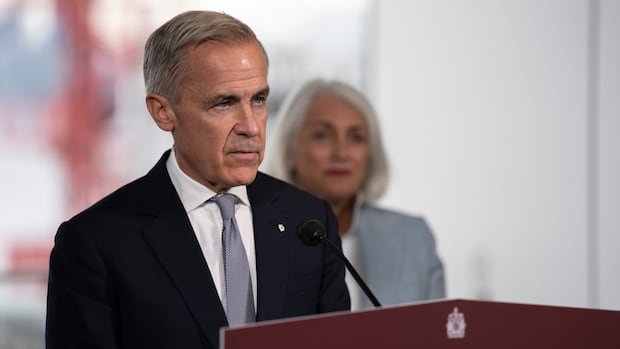

Prime Minister Mark Carney unveiled a $1.2 billion federal funding initiative for ocean conservation on Tuesday, coinciding with upcoming decisions on a new West Coast pipeline project and the expansion of a key port in Metro Vancouver. Carney expressed concerns about the potential impact of these large-scale projects on marine habitats and emphasized the need to enhance protective measures.
The allocated funds will support various initiatives, including boosting the Canadian Coast Guard’s monitoring capabilities for marine traffic, establishing a national near-shore weather forecasting system, and developing a plan to respond to oil spills involving marine mammals. Additionally, the plan involves upgrading search and rescue facilities, enhancing seabed mapping, and improving efforts for fisheries conservation.
During the announcement in North Vancouver, Carney highlighted the importance of scaling up marine protection efforts, especially with the looming decision on a proposed pipeline project that could have significant economic implications. He emphasized the government’s commitment to balancing economic development with environmental protection.
Carney reassured that the proposed pipeline would avoid environmentally sensitive areas and follow a route similar to the existing Trans Mountain pipeline, with the continued ban on tankers along B.C.’s north coast. The government aims to diversify the economy, create new jobs, and reduce reliance on the U.S. market through strategic infrastructure investments.
In a related development, LNG Canada confirmed plans to proceed with the Phase 2 expansion of its Kitimat facility in British Columbia, aiming to double its capacity. Carney has also voiced support for the proposed expansion of the Port of Vancouver’s Roberts Bank terminal, highlighting the government’s efforts to boost exports and strengthen national sovereignty.
As ship traffic increases at the Port of Vancouver, Carney stressed the necessity of implementing robust measures to safeguard marine ecosystems, particularly the endangered southern resident killer whales in B.C.’s waters. Initiatives to address underwater noise affecting marine life, including whales, are underway, with a focus on maintaining noise levels at 2023 standards despite rising vessel traffic.
The funding will also support Indigenous-led stewardship and restoration efforts in the Lower Fraser River Estuary, enhance fisheries enforcement capabilities, and advance collaborative conservation initiatives in the Great Bear Sea region. The government aims to address potential risks associated with increased vessel traffic and economic development, as acknowledged by Coastal First Nations and environmental advocacy groups.
While the funding for oceans protection was welcomed by many stakeholders, concerns were raised about the proportionality of the investment compared to other major projects. Advocacy groups have highlighted potential conflicts between economic development agendas and environmental conservation goals, citing the need for stringent safeguards to protect vulnerable species and ecosystems.