

A researcher is examining the impact of an invasive insect and the chemicals used to combat it on the wildlife in aged hemlock forests. The hemlock woolly adelgid (HWA) has been causing extensive damage to forests in southwestern Nova Scotia for nearly ten years. Various entities, including Parks Canada, the province, local groups, and private landowners, have been employing insecticides like imidacloprid and dinotefuran to control its spread.
However, Mathilde Christjansen, a master’s student at Mount Allison University in Sackville, N.B., highlighted the lack of knowledge regarding the effects of woolly adelgid and insecticides on other species. Imidacloprid, primarily targeting insect nervous systems, has been detected in the brains of other creatures such as fish and tadpoles.
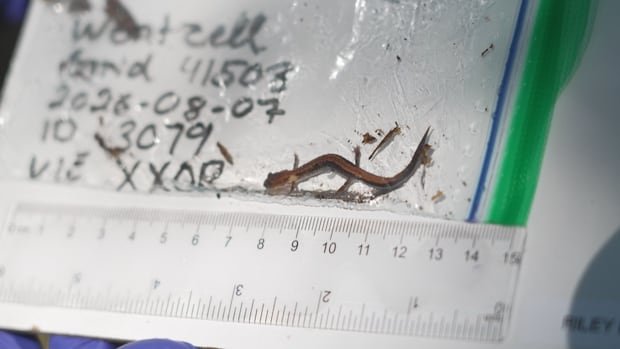
Instead of individually studying all species in every hemlock forest, Christjansen’s team is using the eastern red-backed salamander as a bioindicator species to provide an overview of the ecosystem’s health. The salamander’s sensitivity to environmental conditions and pollutants makes it an ideal indicator of the forest’s overall well-being.
The study involved placing coverboards in forests last year to serve as habitats for salamanders. Researchers monitored these boards periodically to record the salamander population beneath them, conducting measurements and tagging the salamanders in the process. Some forests under study are treated with either or both insecticides for HWA, while others remain untreated.
Behavioral tests were conducted on the salamanders, including gentle prodding to observe their response to predation and flipping them upside down to assess their agility. Christjansen explained that the salamanders’ population size, health, and size relative to those in non-treated forests or treated forests could indicate the broader impact on the ecosystem.
Julia Riley, an associate professor at Mount Allison University and a Canada Research Chair in integrative wildlife ecology, emphasized the salamanders’ significance as forest health indicators due to their responsiveness to environmental changes and their substantial presence in forest ecosystems.
The study also investigates how the decline of hemlock trees affects salamanders. Chris Edge, a supervisor and scientist with the Canadian Forest Service, stated that dying hemlocks compromise the unique habitat features that these trees provide, such as cool and moist microclimates resulting from their dense canopies.
Due to salamanders’ moisture-dependent skin, a drier forest environment caused by reduced foliage coverage could negatively impact salamander populations and behaviors. The project is a collaborative effort involving Mount Allison University, Canadian Forest Service, Acadia University, Environment and Climate Change Canada, and the University of Saskatchewan, as part of a broader study on Eastern Canada’s forest health.
Christjansen plans to conclude her study next year after analyzing the data and field videos collected over the summer. This research aims to shed light on the intricate relationships between invasive species, insecticides, and forest ecosystems, providing valuable insights for conservation efforts.
—
The rewritten article provides a detailed overview of a research project investigating the impact of an invasive bug and insecticides on wildlife in hemlock forests. It emphasizes the use of salamanders as bioindicators and the broader implications for forest health.