
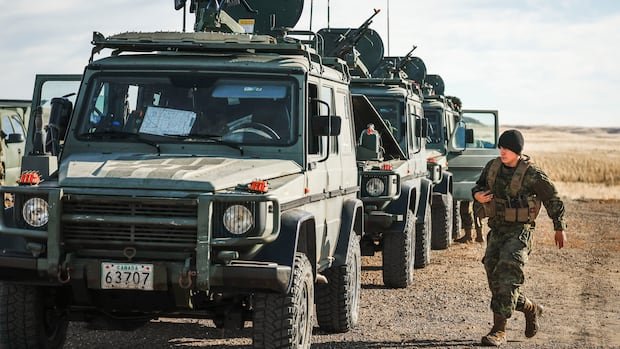

The Canadian government has quietly scrapped the second phase of a longstanding competition to supply the army with light utility vehicles. Instead, they plan to directly invite a limited number of Canadian suppliers to bid on the project, as reported by CBC News. Public Services and Procurement Canada (PSPC) released a notice indicating a shift to an updated procurement approach.
The cancelled invitation was for interested companies to qualify for bidding on the Light Utility Vehicle (LUV) program, which has a potential value of up to $4.9 billion according to the Department of National Defence website. Initially, six primary competitors were identified, including two U.S. companies – AM General and Oshkosh Defence, and four Canadian companies – Armatec Survivability Group, GM Defense Canada, Roshel, and Terradyne Armoured Vehicles.
The government now plans to further narrow down the field. Following the NATO summit in Turkey, the Prime Minister’s Office highlighted new defense investments, mentioning the updated procurement strategy for the LUV program. The statement revealed the intention to limit the tender to two Canadian defense industry suppliers for the delivery of vehicles and light utility trailers for the Canadian Armed Forces’ fleet.
The specific Canadian companies to be selected have not been disclosed yet. The decision to exclude foreign bidders came just before the NATO summit in Ankara and in the wake of the announcement to purchase submarines for the navy from German shipbuilder ThyssenKrupp Marine Systems (TKMS).
The PSPC notice mentioned that refocusing the LUV program aims to strengthen Canada’s defense industrial base. The program has been split into two phases, with the first phase involving the replacement of the army’s aging fleet of Mercedes G-Wagons and Chevrolet Silverados.
Additionally, Canada is set to invest $800 million in a contract with Norwegian company Kongsberg Defence and Aerospace for joint strike missiles (JSM). These advanced anti-ship and land-attack missiles are designed for use with F-35 stealth fighters. Furthermore, an agreement in principle has been reached for the Enhanced Satellite Communications Project – Polar (ESCP-P) to utilize the Telesat Lightspeed system for military satellite communications in the Arctic, potentially worth up to $5 billion.