

The conflict in Gaza escalated following an incursion by Hamas-led militants into southern Israel on October 7, 2023, resulting in approximately 1,200 casualties, predominantly civilians, and the abduction of 251 individuals. Currently, 48 hostages, with fewer than half presumed to be alive, are still held in Gaza.
Reports from the Hamas-run health ministry in the region indicate that over 64,964 individuals have lost their lives in Israeli offensives in Gaza since the initial incident. The destruction of more than 90 percent of residences has left the infrastructure in disarray, leading to a collapse of essential services like healthcare, water supply, sanitation, and hygiene. Moreover, experts backed by the UN have declared a state of famine in Gaza City due to severe food insecurity.
An independent panel of experts appointed by the United Nations’ Human Rights Council has determined that Israel is engaged in acts of genocide in Gaza. The experts have identified evidence of multiple genocidal acts as defined by international law, including the killing of group members, causing severe physical or mental harm, deliberately creating conditions aimed at destruction, and obstructing births.
Although the expert team was mandated by the Human Rights Council, a key UN human rights body, its findings do not represent the entire United Nations. Israel has strongly refuted the report, labeling it as “distorted and inaccurate.”
However, for the innocent civilians caught in the conflict’s crossfire, the situation transcends politics, religion, or vendetta. These individuals find themselves plunged into a harrowing battle for survival, witnessing unspeakable atrocities and enduring the loss of their loved ones without warning.
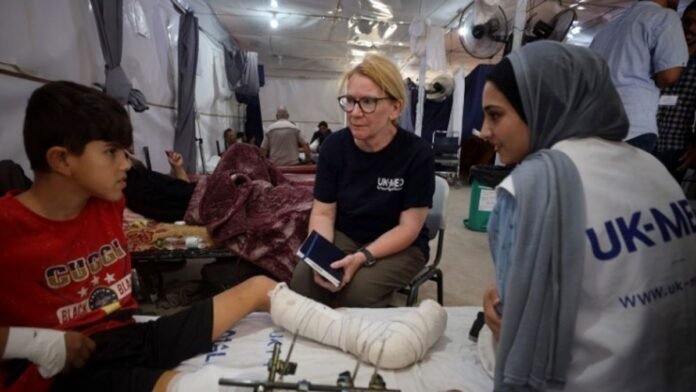
Mandy Blackman, 56, who oversees a field hospital in al-Mawasi within the Gaza Strip for the UK-Med charity, vividly exposes the grim realities of frontline operations to The Mirror…
“Each day starts with the heartbreaking sight of emaciated children attempting to rouse their deceased parents in al-Mawansi, Gaza. Desperate parents plead for essentials like food, diapers, and medical care for their ailing children. Malnourished infants arrive with visible rib cages and sunken faces. I encounter daily cases of gunshot wounds across all age groups and genders, resulting in life-altering injuries. Family members search for children separated in the chaos, while some patients arrive using donkeys and carts.
The news varies for families – some discover their children still alive but grievously wounded, while others receive the devastating notification of their child’s or children’s demise.
This is the stark reality of life on Gaza’s frontlines. Although my usual workplace is Kettering General Hospital in Northamptonshire, I have been deployed to manage a field hospital. I strive to remain composed, yet the scenes I witness often move me to tears.”
I recall a tragic incident where a teenage boy, innocently selling water to support his family, was fatally shot in the head. He was peddling water in small plastic bags, akin to those used at carnivals for goldfish, when the tragedy struck. Bystanders brought him to our facility, where his parents were present as he passed away.
<p class="Paragraph_paragraph-text__PVKlh " data-t